

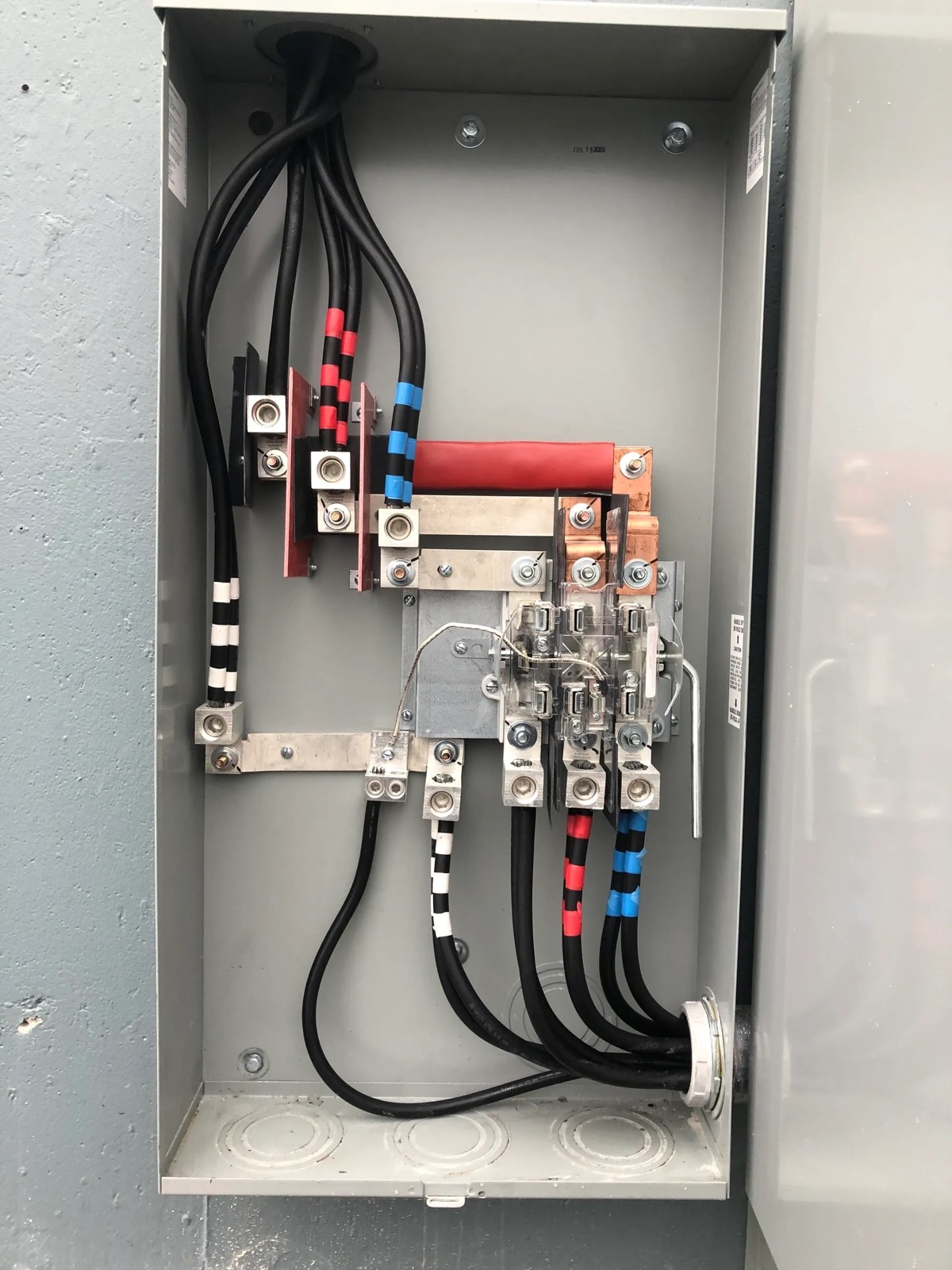
Commercial Wiring and Circuits in New Hampshire and Massachusetts
Branch circuits, conduit and cable, receptacles and power where the work happens, in offices, restaurants, retail units, warehouses and production space across Manchester, Nashua, Concord, Portsmouth, Dover and over the line into Lowell, Lawrence and Haverhill.
Commercial and Industrial Wiring Work in New Hampshire
How Commercial Wiring Differs From Residential
The physical methods are different, the loads are heavier, and the standards a commercial installation is held to are stricter in ways that are visible on site.
Most commercial wiring runs in conduit or armored cable rather than the plastic-sheathed cable used in houses. EMT, rigid conduit and MC cable are the normal methods, chosen for mechanical protection, for the ability to pull new conductors later, and because in many commercial occupancies the code requires them. Wiring in a commercial kitchen, a warehouse or a production area has to survive an environment a residential wall never sees.
The work covers the commercial and industrial areas across this region: the Manchester millyard and industrial park, the Nashua and Merrimack corridor along the Everett Turnpike, Concord's commercial districts, Pease International Tradeport and Newington on the Seacoast, Dover, Rochester and Somersworth, the I-93 towns of Salem, Derry and Londonderry, and the Massachusetts side in Lowell, Lawrence, Haverhill, Methuen, Andover, Tewksbury and Dracut.
Both states are licensed. New Hampshire master license 14569M, with a separate Massachusetts license for work over the border.
Adding Circuits and Power to a Working Building
The most common commercial wiring job is not a new installation. It is adding power to a building that is already running, for equipment that was not there before.
A new machine on a shop floor. A coffee station in an office. A rack in a server room. Four new registers in a retail unit. Heaters in a warehouse. The electrical is usually straightforward; the difficulty is doing it in an occupied space without shutting the business or disturbing what is already working.
That means routing a circuit through a building that is trading, working out where the tie-in can be made, and finding a window for the parts that need the power off. Most of it can be done live from the load side, and the small number of items that cannot get scheduled rather than improvised.
It also means being honest about whether the circuit is the answer. A panel with no spare ways needs distribution work rather than another circuit squeezed in, which is where service and switchgear comes into it.
Wiring Methods for Commercial and Industrial Spaces
The method is chosen for the environment rather than for convenience, and this is one of the clearest differences between good and poor commercial work.
EMT is the general-purpose commercial method: mechanically protected, allows conductors to be pulled and replaced, and it looks like what it is. MC cable is faster where it is permitted and appropriate, particularly above accessible ceilings. Rigid and intermediate conduit go where impact is likely, in loading areas, plant rooms and exposed exterior runs.
Wet, damp and corrosive locations change the answer again. A car wash, a food processing area, a walk-in cooler and an exterior wall each need methods and fittings rated for what they see, and the fitting matters as much as the raceway. A compliant conduit with a non-rated fitting is a non-compliant installation.
Support and spacing are where a rushed installation shows. Straps at the right intervals, boxes properly secured, expansion fittings where they are needed, and conductors sized for the length of the run rather than for the load alone.
Rewiring Older Commercial and Mill Buildings
A large part of the commercial building stock here dates from the mill era or the decades after, and much of it has been rewired piecemeal since.
The typical building in the Manchester millyard, along the Merrimack in Lowell and Lawrence, or in the brick blocks of downtown Nashua, Concord or Dover carries several generations of wiring at once. Original cloth-covered conductors, a mid-century rewire, and whatever the last four tenants added. Junctions above ceilings that nobody can trace, abandoned circuits that are still live, and panels fed from other panels.
A full rewire is rarely what happens or what is needed. What happens is a section at a time, usually driven by a tenant fit-up or a change of use, with the abandoned material removed as the new work goes in.
Our guide to fitting out an older commercial building covers what a survey typically finds in a building like that, and why the survey carries more weight than the drawings.
Receptacles, Floor Boxes and Power at the Workstation
Getting power to where people actually work is a layout problem before it is an electrical one.
In an office that means floor boxes or poke-throughs under the desk positions, or power in the furniture system, decided by the furniture plan rather than by the wall positions. In retail it means power at the till points, the fitting rooms and the window display. In a warehouse it means drops at the packing benches and receptacles that survive being hit by a pallet truck.
Commercial receptacle requirements differ from residential in the details that catch people: GFCI protection in more locations, specific receptacle configurations for particular loads, and dedicated circuits where equipment demands them.
The recurring failure is a space fitted out to a generic layout and then occupied differently, which produces extension leads across floors. That is a safety problem and a trip hazard, and it is the symptom of an electrical layout that was never matched to the work.
Dedicated Circuits for Equipment and IT
Some loads share a circuit safely and some do not, and getting that wrong produces faults that look mysterious.
Server racks, point of sale systems, medical and imaging equipment, kitchen equipment and anything with a motor generally want their own circuit. Sharing a sensitive electronic load with a motor load puts the motor's starting behavior onto the same conductors as the electronics, which is a common cause of equipment that resets for no apparent reason.
IT and point of sale circuits are worth identifying clearly at the panel, because they are the ones somebody will eventually need to isolate under pressure. Clear labeling is not decoration; in a commercial panel it is part of the installation.
Where the equipment is heavy or hardwired rather than plugged in, equipment and machine connections covers the disconnect, the controls and the sizing.
Fault Finding and Repairs in Commercial Buildings
A commercial fault is usually reported as a symptom rather than a cause, and the diagnosis is most of the work.
A breaker that trips intermittently, a circuit that drops out when a particular machine runs, lights flickering on one floor, a receptacle that stopped working and nobody knows which breaker it is on. In a building with poor records that starts with establishing what is fed from where, which in an older building is rarely quick.
The temptation is to replace the breaker. A breaker that trips is almost always doing its job, and swapping it removes the warning rather than the fault. The useful questions are what changed, what is on that circuit, and whether the load grew past what the circuit was ever sized for.
Where a fault is urgent and the business is losing trading time, 24 hour commercial emergency work is the same job with a different response. Where it keeps recurring, it is usually a sign the building needs scheduled maintenance rather than repeated call-outs.
Labeling, Records and Leaving the Building Understandable
On a commercial job the documentation is part of the deliverable, and it is the part most often skipped.
A correct panel schedule, circuits labeled at both ends, and a record of what changed means the next person to work on the building, which may be somebody else entirely, is not starting from nothing. In a multi-tenant building it also means a manager can isolate a unit without guessing.
The reason it gets skipped is that it is the last thing on a job that is already running late, and nobody inspects it. The reason it matters is that every hour spent tracing an unlabeled circuit for the next twenty years is a direct cost of not doing it.
For buildings under property management, where circuits change with every turnover, keeping the schedule current is the difference between a building that is manageable and one that is not.
What Commercial Wiring Covers
- Branch circuits for equipment, lighting, receptacles and IT
- EMT, rigid conduit and MC cable installations
- Wet, damp and corrosive location wiring with rated fittings
- Floor boxes, poke-throughs and workstation power
- Dedicated circuits for servers, point of sale and sensitive equipment
- Sub-panels and feeders where a building needs local distribution
- Rewiring sections of older and converted commercial buildings
- Removal of abandoned circuits and legacy wiring
- Fault finding, diagnosis and repair in occupied buildings
- Panel schedules, labeling and a record of what was done
Signs a Commercial Building Needs Wiring Work
- Extension leads running across floors or between rooms
- A breaker that trips when one particular machine starts
- Equipment resetting or faulting for no apparent reason
- A panel schedule that no longer matches what is on the circuits
- New equipment arriving with nowhere to plug it in
- Wiring visible that is cloth covered, brittle or spliced outside a box
- Circuits nobody can trace and panels with no identified source
- A space being reoccupied for a different use than it was fitted for
Commercial Wiring & Circuits Questions, Answered
Can Commercial Wiring Be Done While the Business Stays Open?
Most of it, yes. New circuits can usually be run and terminated with only a brief isolation at the panel. Work on the service, the main gear or a shared feeder needs a planned window, and those are the items worth scheduling out of hours rather than fitting around trading.
Why Does Commercial Wiring Use Conduit Instead of Cable?
Mechanical protection, the ability to pull new conductors later without opening walls, and because many commercial occupancies require it. A commercial building changes use far more often than a house, and a raceway means the next change is a pull rather than a rebuild.
A Breaker Keeps Tripping. Can It Just Be Made Bigger?
No. The breaker protects the conductors, so a larger one removes the protection instead of fixing the cause. A repeatedly tripping breaker means the load has grown past what the circuit was sized for, or there is a fault. Both need finding rather than covering.
Do You Remove Old Wiring, or Just Add to It?
Abandoned material comes out as the new work goes in, which is both a code matter and a practical one. Leaving dead circuits in a ceiling is how the next contractor ends up tracing something that goes nowhere.
Can You Find Out What an Unlabeled Circuit Feeds?
Yes, and in older commercial buildings it is a regular part of the work. It takes time, particularly where panels feed other panels, but it is the necessary first step before anything is safely modified.
Do Server Rooms Need Special Wiring?
They need dedicated circuits rather than shared ones, adequate capacity for the load including cooling, and clear identification at the panel. Sharing a rack circuit with a motor load is a common cause of equipment that resets unpredictably.
Who Pulls the Permit for Commercial Wiring Work?
We do, under the master electrician license, in whichever state the building is in. Most commercial wiring beyond the smallest repair is permitted and inspected work.
Guides on Commercial Wiring & Circuits
Three-Phase Power: What It Is and When a Business Needs It
Why some equipment will not run on single phase, and what bringing three phase into a building involves.
Keeping a Business Open During Electrical Work
What genuinely cannot be done live, how work gets phased, and why the schedule is the real cost.
Electrical in Multi-Tenant and Mixed-Use Buildings
House panels, sub-metering, who pays for what, and the questions to settle before a tenant moves in.
Other Commercial Electrical Work
Tenant Fit-Ups & Build-Outs
Restaurants, retail, offices and warehouses, rough-in to trim.
Service, Distribution & Switchgear
Three-phase service, panelboards, transformers and feeders.
Commercial Lighting
LED retrofits, parking lot and site lighting, controls, high-bay.
Low Voltage & Systems
Data cabling, intercom, surveillance and access control.
Maintenance & Service Contracts
Scheduled maintenance, thermal scanning, planned replacement.
24 Hour Commercial Emergency
Downtime response, storm and outage work, temporary power.
Property Management & Multi-Family
Common areas, apartment buildings, turnovers, house panels.
Equipment & Machine Connections
Kitchen equipment, motors, rooftop units and process circuits.
Commercial Generators & Emergency Power
Standby systems, automatic transfer switches, life safety power.
Commercial EV & Fleet Charging
Workplace charging, fleet charging, multi-port installations.
New Construction & GC Work
Ground-up commercial, design-build, subcontracting to GCs.