

Keeping a Business Open During Electrical Work
Which minutes of a commercial job genuinely need the power off, and how to move those to a window that costs the business nothing.
Published
How to Keep a Business Trading Through Electrical Work
Can Electrical Work Be Done While a Business Stays Open?
Electrical work in a trading business can almost always be done without closing, and the exceptions are narrower and shorter than most people expect. The question is not really whether the business can stay open. It is which minutes of the job genuinely need the power off, and whether those minutes can be moved to a time that costs nothing.
Almost everything downstream of the panel can be done live or circuit by circuit. Adding runs, installing fixtures, pulling cable, roughing in new areas, first fixing a new space behind a hoarding. None of that needs the building dead, and a great deal of it does not need any individual circuit dead for long.
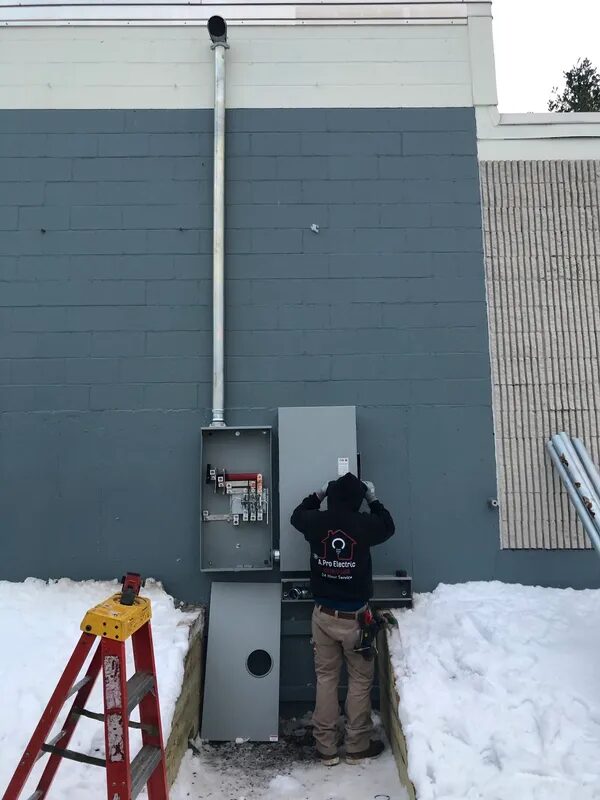
What needs a dead panel is the connection at the board: landing a new circuit, changing a breaker, working inside the enclosure. That is minutes per circuit rather than hours, and it is schedulable.
The jobs that genuinely need a shutdown are service and switchgear work, where the incoming supply itself is being replaced or upgraded. Those are planned, they are usually a known number of hours, and they are almost always done overnight or on a closed day. Service and switchgear work is the one category with a genuine shutdown attached.
It is the question we are asked most often by trading businesses across Portsmouth and the Seacoast, Manchester, Nashua, Concord, Salem and Keene, and in Lowell, Lawrence, Haverhill and Methuen over the Massachusetts border.
How Do You Plan Electrical Work Around Trading Hours?
By separating the work into what can happen during trading, what needs a quiet period, and what needs the power off, then scheduling each into the right window.
The first category is most of the job and it happens whenever suits, whether that is adding circuits and outlets or first fixing a new area behind a hoarding. The second covers anything noisy, dusty or in the way of customers, which in a restaurant means before service and in retail means early morning. The third is the panel work, and it is the only part with a hard constraint.
The sequence that works is to do all the preparation first so the shutdown window is as short as possible. Every cable run, every box set, everything terminated and ready, so that when the power does go off the work is connection rather than installation. A well-prepared changeover that takes forty minutes at six in the morning is a completely different proposition from an open-ended shutdown.
For a Portsmouth restaurant, a Salem retail unit or a Manchester office the practical answer is nearly always the same: the disruptive part is small and it can be moved to a time when the business is closed anyway.
How Long Does the Power Actually Have to Be Off?
For most commercial jobs, minutes per circuit. For service work, a planned window that is known in advance rather than discovered on the day.
Landing a new circuit into an existing panel is a short operation once everything is prepared. Changing a breaker is shorter. Working inside the enclosure with the panel dead depends on what is being done, but on a straightforward job it is measured in tens of minutes rather than hours.
A service change or a switchgear replacement is a different scale and it is the one that needs a real window. Those are typically overnight or on a closed day, they frequently involve the utility, and the duration is estimated in advance because the work is sequenced rather than exploratory.
What extends a shutdown unexpectedly is nearly always what is found rather than what was planned. Opening a panel in an older building and discovering terminations that have been running hot, circuits that were never labeled, or feeds to equipment nobody can account for is common in the mill conversions and the older downtown stock. A survey beforehand converts most of those from surprises into line items.
What Is Temporary Power and When Is It Worth It?
Temporary power keeps specific things running while the supply they normally use is out of service, and for some businesses it turns a shutdown from impossible into routine.
The common arrangements are a generator feeding a temporary distribution board, a temporary feed from another part of the building, or a portable unit dedicated to one critical load. Which is appropriate depends on what actually cannot lose power.
It earns its cost where the consequence of an outage is larger than the cost of avoiding it, and on sites where that is a recurring risk a permanent standby supply is usually the better answer than temporary hire. Refrigeration in a restaurant or a food retailer, where a few hours means stock. Servers and network in an office, where an unplanned outage is worse than a planned one. Medical and dental practices with equipment and records. Anything with a process that cannot simply be restarted.
For many businesses it is unnecessary, because the work can be scheduled into a closed period instead, and saying so is more useful than selling it. It is worth pricing where the closed period does not exist or is not long enough, which is the position a lot of hospitality and convenience trade is in.
What Electrical Work Can Be Done Out of Hours?
Most of the disruptive parts, and out of hours is genuinely normal on commercial work rather than an exception we grudgingly accommodate.
Panel and switchgear work, service changes, anything needing the building dead, and anything requiring a lift in a customer area all sit naturally outside trading. So does work in a space that has to be clear, such as a dining room or a shop floor.
What is worth knowing is that out of hours does not automatically mean the middle of the night. A restaurant is closed for a long stretch every morning. A retail unit has hours before it opens. An office is empty all weekend. Those windows are usually enough, and they cost less than a genuine overnight callout.
For a business that trades continuously, or nearly so, the conversation becomes about temporary power and about sequencing the work so each phase is short. After-hours and emergency work is answered around the clock either way, and planned out-of-hours work is easier to resource than unplanned.
How Do You Keep Dust and Disruption Out of a Trading Area?
By containing the work rather than by rushing it, and the containment is usually the difference between a job customers notice and one they do not.
Hoarding a work area off is standard on any fit-up or build-out inside a trading building and it does more than hide the work. It controls dust, it keeps the public away from tools and open floors, and it means the area behind it can be worked normally rather than tidied every hour.
For work in an occupied area, the useful measures are unglamorous, meaning protecting finishes, cutting where extraction can reach, and doing anything that generates dust before opening rather than during. Drilling into a Manchester Millyard brick wall or an old Lowell mill floor generates a remarkable amount of it, and that is a planning item rather than a cleanup one.
The other half is access routes. Getting cable, fixtures and a lift in and out of a building without crossing a customer area is worth working out in advance, particularly in a multi-tenant building where the route is shared with other businesses.
What Should a Business Ask Before Electrical Work Starts?
Four questions, and the answers should be specific rather than reassuring.
Which parts of this need the power off, and for how long. What is the plan if something is found once the panel is open. What happens out of hours and what happens during trading. And who is on site when, because a business needs to know which days involve people in the building.
A contractor who cannot answer the first two has not surveyed the job properly, and on a building with any age to it a documented survey is what makes the answer possible. The second question in particular separates a priced job from a hopeful one, because in older commercial buildings something usually is found, and the difference between a good job and a bad one is whether that was anticipated.
It is also worth asking what the inspection schedule looks like, since inspections are the town's to give and they sit on the critical path.
Electrical work in a trading business is a scheduling problem far more than a technical one, and it is solved before anyone arrives on site. We work around trading hours across Portsmouth and the Seacoast, Manchester, Nashua, Concord, Salem and Keene, and in Lowell, Lawrence, Haverhill and Methuen on the Massachusetts license.
Last updated
Working Around Trading Questions
Will the Whole Building Lose Power?
Only for service or switchgear work, and then for a planned window known in advance. Most commercial work needs individual circuits dead for minutes at a time rather than the building, and that can be scheduled into a closed period.
Can Electrical Work Be Done Overnight?
Yes, and it is normal on commercial jobs. It is also worth knowing that out of hours rarely means the middle of the night. A restaurant is closed all morning, a shop has hours before it opens and an office is empty all weekend, and those windows are usually enough.
What Happens If You Find a Problem Once the Panel Is Open?
You are told before anything else happens, with what it is, what it affects and what the options are. In older commercial buildings something is usually found, which is why a survey before the job is worth the afternoon it takes and why a fixed price without one is optimistic.
Do We Need to Move Stock or Equipment?
Only where access requires it, and it is worth establishing at survey rather than on the day. A lift in a warehouse needs floor space and a clear route, and the arrangement for that is a scheduling conversation rather than an electrical one.
Can Refrigeration Stay Running During the Work?
Usually yes, either by sequencing the work so those circuits are never the ones dead, or with temporary power where the shutdown cannot avoid them. For a food business that is normally the first thing planned around rather than the last.
How Much Notice Do You Need for a Shutdown?
Enough to prepare everything so the window is short, which is generally the difference between a forty minute changeover and an open-ended one. Where the utility is involved their notice period governs, and that is usually the longer of the two.
The Work Behind This Guide
More Guides for Businesses
Planning the Electrical for a Restaurant Fit-Up
Kitchen equipment loads, the inspection sequence, and the decisions that are expensive to change late.
Three-Phase Power: What It Is and When a Business Needs It
Why some equipment will not run on single phase, and what bringing three phase into a building involves.
LED Retrofit: Working Out the Payback
Fixture count, running hours and rate, and how to tell a real payback figure from a sales one.