

Electrical Panel Upgrades and Service Upgrades in New Hampshire
Panel replacement, 200 amp service upgrades, Federal Pacific and Zinsco removal and fuse box conversions, across Manchester, Concord, Nashua and the towns around them. Permitted, inspected, and a single day on most houses.
What an Electrical Panel Upgrade Involves in a New Hampshire House
Panel Replacement Against a Full Service Upgrade
An electrical panel upgrade replaces the panel, and often the service feeding it, so a house has both working protection and enough capacity for how it is actually used. Those are two separate jobs that get the same name, and which one you need changes both the scope and the price.
Replacing the panel alone means new equipment on the same size service. That is the job where the service is genuinely adequate at 100 or 150 amps but the panel itself is obsolete, defective or full. A Federal Pacific or Zinsco panel on a service that is big enough is exactly this case.
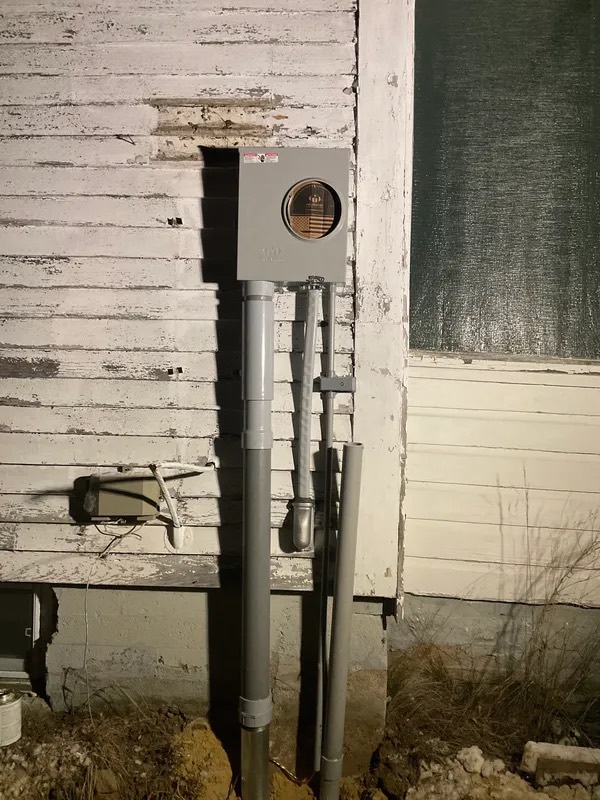
A service upgrade means more capacity, which brings in the service entrance conductors, the meter socket, the mast and the utility. That is the job where the house has outgrown 100 amps, which in New Hampshire usually means a heat pump, an EV charger or an induction range arriving at a house wired when the heat was oil.
We do both across Manchester, Concord, Nashua, Derry, Salem, Bedford, Henniker, Laconia and Keene, and the first thing we establish is which one the house actually needs rather than quoting for the larger.
When a New Hampshire House Needs a 200 Amp Service Upgrade
When the load calculation says so, and in practice that is when two or more significant electric loads arrive, or when one arrives at a house that was already close to its limit.
The triggers are consistent. A heat pump replacing oil or propane, which is the biggest single change most New Hampshire houses make. An EV charger, and a 48 amp unit more than a 40 because it is counted at 125 percent. An electric water heater. A hot tub, which is heavy and runs at all hours. A finished basement, an addition or an ADU.
A 200 amp service upgrade runs $3,000 to $3,500 for a straightforward job. What moves it is the service entrance rather than the panel, meaning whether the mast and meter socket need replacing, whether the panel is relocating, and what the grounding needs. Older houses in Concord, Manchester and the surrounding towns usually need some combination of those.
If the question is capacity rather than condition, answer it before anybody quotes. The load calculator runs the same Article 220 method we do and will tell you whether the house is comfortable, borderline or short.
Federal Pacific, Zinsco and Challenger Panel Replacement
Three brands come up repeatedly and the concern is the same in each, which is that the part that fails is the part whose whole job is protection.
Federal Pacific Stab-Lok breakers have a documented record of not tripping when they should. Zinsco fails differently, at the busbar, where the aluminum bus corrodes at the point the breaker clips onto it and heat builds at the joint. Challenger has a known issue with certain breakers overheating at the bus stab.
None was ever formally recalled, and Federal Pacific in particular is widely described as recalled when it is not. The Consumer Product Safety Commission closed its investigation in 1983 without one, on resources rather than on findings. The accurate position is less comfortable rather than more: never recalled, and treated as a defect by inspectors and insurers regardless.
If you are not sure what you have, the panel identification tool walks through what to look for from the front of the panel without taking the cover off, which is not a homeowner job.
A Full Panel and an Unsafe Panel Are Different Problems
A full panel is a capacity problem and an unsafe panel is a safety problem. They need different work, and a panel can easily be one without being the other.
Full means no spare spaces to land another breaker, and it has more than one answer. A sub-panel often suits where the new load is concentrated in one place such as a garage, a workshop or a finished basement, and a feeder out to an outbuilding is frequently tidier than six individual circuits. Tandem breakers are sometimes permitted depending on the panel and what its label says.
Unsafe means the protection cannot be relied on, whether that is a defective brand, heat damage, water ingress, a busbar that has been arcing, or terminations that were never torqued properly. Finding space fixes none of that.
The visible symptom is often the same, which is a breaker tripping, and separating the two is most of the diagnosis. Our guide to why breakers trip covers the circuit side of that question.
Fuse Box to Breaker Conversion
Not automatically, and anybody saying otherwise without looking is selling rather than advising. A fuse box that is sound, dry, correctly fused and not overloaded is not an immediate hazard.
What makes it one is what usually happened to it. A fuse that keeps blowing gets replaced with a bigger one, because a 30 amp fuse fits the same holder as a 15 and nothing physically prevents it. That removes the protection from the circuit entirely, and over-fused circuits in an old box are closer to the rule than the exception.
Then everything else that comes with a box of that age. No grounding conductor on the branch circuits, no GFCI at kitchens, bathrooms or outdoors, cloth-covered cable gone brittle, and nowhere near enough circuits. In the pre-1950 stock around Keene, Concord, Hopkinton, Warner and Bradford that often means knob and tube still in service, which is a rewiring conversation rather than a panel one.
A fuse box to breaker conversion is usually worth doing, usually alongside other work, and almost never an emergency.
What Happens on the Day of a Panel Replacement
It is permitted and inspected work, and it is a single day on most houses with the power off for part of it.
The utility disconnects at the meter or the service is pulled. Every circuit is identified and labeled as it lands, which sounds like housekeeping and is one of the most valuable parts of the job, because a correctly labeled panel turns the next fault from an hour of tracing into two minutes. Grounding and bonding are brought up to current requirements, which on an older house is the least visible and most worthwhile part of the work. Terminations are torqued to specification, since loose and over-tight connections are both causes of the heat that panels get blamed for.
Then the town inspects it. That record is what a buyer's attorney asks about, what an insurer may want after a claim, and what protects you if a future owner questions the work.
Where the panel is being replaced because something was found in a sale or an insurance review, an electrical safety inspection is often the better starting point, because it establishes the whole scope rather than treating the panel as the entire story.
Permits and Inspection for Panel Work in New Hampshire
Yes. Panel and service work is permitted and inspected, the permit is pulled by the licensed electrician doing the work, and the town carries out the inspection.
New Hampshire licenses electricians in tiers, and a master license is the level that can pull permits and carry responsibility for the work. Austin Provencher holds New Hampshire master license 14569M, which is checkable against the state register rather than being a claim on a website.
Unpermitted electrical work found during a sale is one of the more common reasons a closing is delayed, and putting it right retrospectively always costs more than doing it properly the first time.
It is also worth knowing that the incoming service conductors stay live with the main breaker off, which is why a panel has no safe do-it-yourself version.
What an Electrical Panel Upgrade Costs in New Hampshire
A 200 amp service upgrade runs $3,000 to $3,500 for a straightforward job. That is a real working range rather than a national average, and it covers the common case of an accessible panel, a service that can be upgraded where it already sits, and nothing unexpected behind the drywall.
What moves it is rarely the panel itself. A mast, meter socket or service drop needing replacement brings the utility into the schedule. A panel moving to a different wall means every circuit has to reach the new location. Grounding brought up to current requirements on an older house means ground rods and bonding rather than a box swap.
The other variable is what the work uncovers. Taking a forty year old panel off a wall sometimes reveals circuits that were never right, terminations that have been running hot for years, or aluminum branch wiring that needs proper remediation. That is work which was always needed and was invisible until the cover came off.
Whatever it comes to, a panel is not a component anybody replaces twice, and the cost of getting it wrong is the part nobody prices.
What Panel and Service Work Covers
- Panel replacement on the existing service size
- 200 amp service upgrades, including service entrance and meter socket
- Federal Pacific, Zinsco and Challenger panel replacement
- Fuse box to breaker conversion
- Mast and service entrance repair after storm damage
- Sub-panels for garages, workshops, basements and additions
- Feeders to detached garages and outbuildings
- Load calculations to Article 220 before anything is quoted
- Grounding and bonding brought up to current requirements
- Every circuit identified and labeled, and the panel left documented
Signs a Panel Needs Looking At
- Warmth anywhere on the panel or on a breaker
- A smell of hot plastic, or scorching around a breaker
- Buzzing or crackling from inside the enclosure
- A breaker that will not reset, or trips again immediately
- Federal Pacific, Stab-Lok, Zinsco or Challenger on the door
- Fuses rather than breakers
- No spare spaces left, or tandem breakers doubled up
- Rust or water staining inside the enclosure
- Lights dimming when the well pump or the furnace starts
- An insurer or a home inspector has raised it
Electrical Panels & Service Questions, Answered
How Long Does a Panel Upgrade Take?
Most residential panel changes are a single day with the power off for part of it. Jobs that run longer do so for a known reason such as a service entrance replacement or relocating the panel, and that is established before the work starts rather than discovered during it.
Will I Be Without Power All Day?
Not usually all day, but expect a substantial part of one. It is worth planning around anything that cannot lose power, particularly a home office, medical equipment or a freezer, and we will give you the likely window before the day.
Does a Bigger Service Cost More to Run?
No. The service size is the capacity available to you rather than the amount you use. A 200 amp service does not draw more than a 100 amp service, it simply does not run out, and the bill reflects what the house actually consumes either way.
Can You Add Circuits Without Replacing the Panel?
Often yes. A sub-panel adds spaces where the new load is concentrated in one area, and tandem breakers are sometimes permitted depending on the panel. Whether that is the right answer depends on whether the service has capacity, which is a load calculation rather than a guess.
Does Replacing the Panel Mean Rewiring the House?
No, they are separate jobs. A panel replacement changes the equipment the circuits land in and leaves the existing wiring in place. If the wiring also needs work it gets identified, but one does not automatically mean the other.
Is a Federal Pacific Panel Actually Dangerous?
The documented concern is breakers failing to trip when they should, which removes the protection the rest of the house assumes is working. It does not mean a fire is imminent. It means the margin is not there, which is why inspectors and insurers treat it as a defect even though it was never formally recalled.
What Size Panel Should I Get?
It is decided by a load calculation rather than by preference. For most New Hampshire houses adding any electric heat, an EV or an induction range, 200 amps is the sensible answer, and it is worth sizing for what is coming rather than only for today.
Guides on Electrical Panels & Service
How to Tell If Your Electrical Panel Needs Replacing
The signs worth acting on, the panel brands insurers flag, and how to tell a full panel from an unsafe one.
What Size Electrical Service Does a House Need?
100, 150 or 200 amps, what pushes a house from one to the next, and how to work out where yours sits.
Getting a Home Ready for an EV
What to check before you order the car, and why the charger is rarely the expensive part.
Other Residential Electrical Work
Wiring & Rewiring
Whole-house rewiring, knob and tube removal, added circuits.
Lighting
Recessed lighting, fixtures, exterior and landscape lighting.
EV Charger Installation
Level 2 chargers, 240 volt outlets, service capacity for an EV.
Generators & Backup Power
Transfer switches, standby generator wiring, portable inlets.
Remodels & Additions
Kitchens, bathrooms, basements, additions and new builds.
Appliance & Specialty Circuits
Hot tubs, well pumps, ranges, dryers and heat pump circuits.
Safety, Inspections & Repairs
Safety inspections, code corrections, surge and detector work.
24 Hour Emergency
Power loss, scorched panels, storm damage, repeat tripping.