

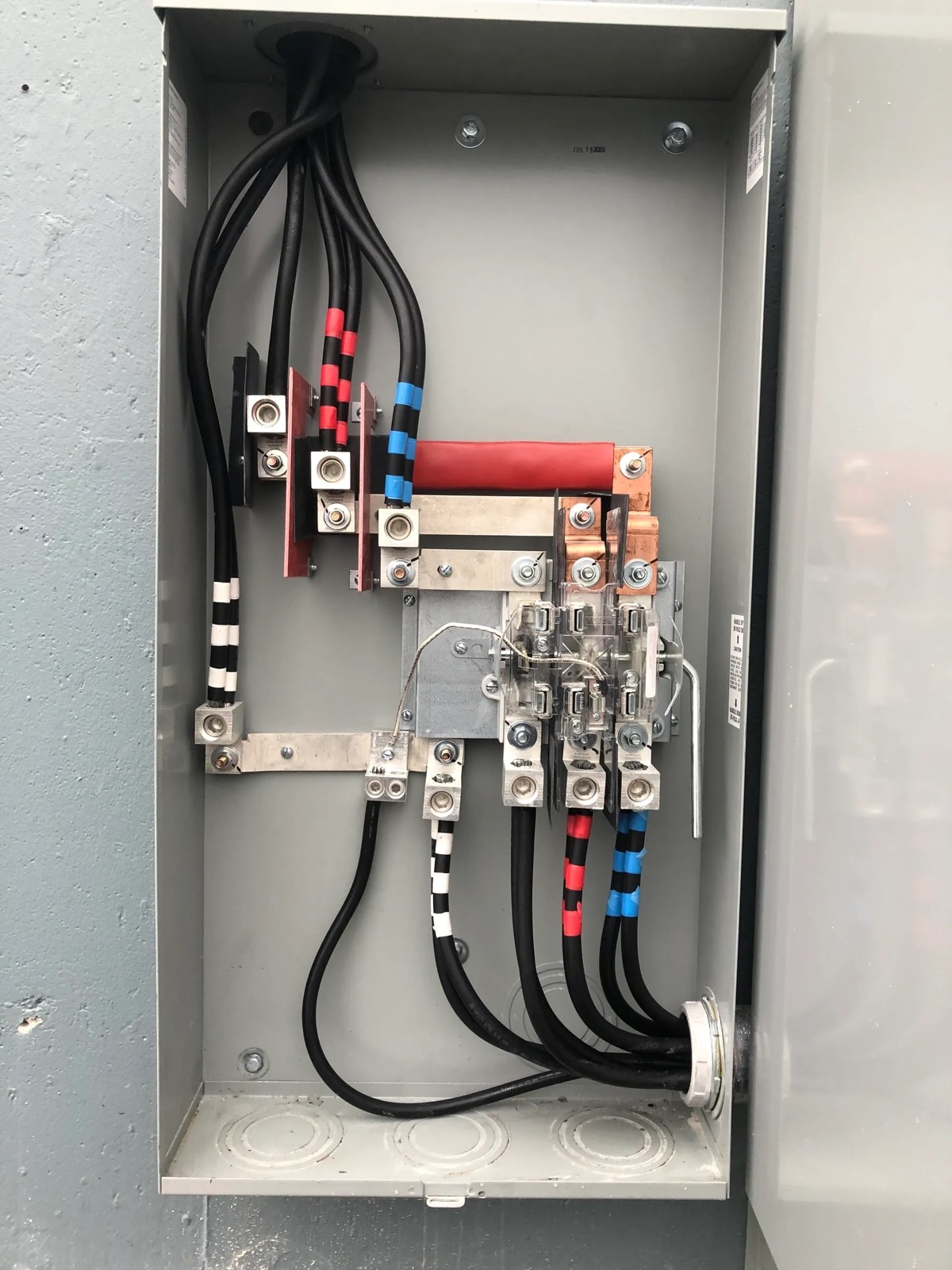
Machine and Equipment Connections for NH and MA Businesses
Getting power to the equipment a business runs on: production machinery, commercial kitchen equipment, compressors, HVAC and motors, across Manchester, Nashua, Concord, Portsmouth, Rochester and the Massachusetts border towns.
Connecting Machinery and Commercial Equipment on Site
What an Equipment Connection Involves
Delivering a correctly sized circuit to the machine, providing the disconnecting means the code requires, making the final connection to the equipment, and confirming it runs correctly including rotation on three-phase motors.
It sounds like the last five percent of a project and it frequently is, but it is also the part most likely to reveal that something earlier was wrong. A machine that will not start, runs backward, or trips on load is usually telling you about the supply rather than about itself.
We do this work across the industrial base of the region: the machine shops and manufacturers around Manchester, Hooksett and Bedford, the plants along the Everett Turnpike corridor in Nashua and Merrimack, the industrial areas of Rochester, Somersworth and Dover, Pease International Tradeport and Newington on the Seacoast, Keene to the west, and over the border in Lowell, Lawrence, Haverhill, Methuen, Andover and Tewksbury.
Massachusetts is a separate license from the New Hampshire master license, and both are held, which matters for manufacturers with plants either side of the line.
The Nameplate Decides Everything
Every connection starts with the equipment nameplate, and this is where most problems originate.
The nameplate gives voltage, phase, full load current, and frequently a minimum circuit ampacity and a maximum overcurrent protection figure, which are the numbers the installation is actually designed from. Sizing from a catalog description, from the model that was replaced, or from what the supplier said on the phone is guessing, and guessing here produces either a circuit that trips or one that does not protect.
Motor loads need the additional consideration that starting current is a multiple of running current. A circuit sized only to the running figure will trip every time the machine starts, which people then treat as a machine fault.
This is also why equipment has to be selected before the circuit is designed. On a fit-up or a new build, the equipment schedule is the electrical design, and a late substitution to a different model is a change to the electrical work rather than a like-for-like swap.
Three-Phase Equipment and Motor Connections
Most commercial and industrial equipment of any size is three phase, and a lot of it is not available any other way.
That makes the first question whether the building has three phase at all. Buildings in established commercial and industrial areas usually do; converted buildings, rural sites and older retail frequently do not, and the answer determines whether a machine can be installed at all or whether a service change comes first. Our guide to three-phase power covers how to establish what a building already has.
Rotation is checked on every three-phase motor connection. A motor running backward can damage pumps, compressors and machine tools, sometimes immediately, and it is a two-minute check that prevents an expensive afternoon.
Motor circuits also need the right protection arrangement: overload protection sized to the motor, short circuit protection sized to allow starting, and the disconnecting means in sight of the machine so it can be isolated by whoever is working on it.
Commercial Kitchen Equipment
Food service equipment is a category of its own because there is so much of it, the loads are heavy, and several items interlock with systems other trades are responsible for.
Combi ovens, fryers, ranges, griddles, warewashers, walk-in refrigeration, ice machines, proofers and a long list of countertop equipment each need their own circuit sized from its nameplate. The total is frequently larger than the operator expects and it is the number that decides whether the unit's supply is adequate.
The hood is the coordination point. Exhaust and makeup air fans, the hood lights, and the interlock with the fire suppression system all have to work together, and the suppression system's shunt trip has to drop the cooking equipment when it discharges. That is an electrical connection with a life safety function, and it is inspected as one.
Wet and washdown areas need rated equipment and fittings throughout. Our guide to planning the electrical for a restaurant fit-up sets out how the whole sequence runs.
HVAC, Compressors and Building Plant
The mechanical plant is frequently the largest connected load in a commercial building and the one most likely to be added to without anyone rechecking the supply.
Rooftop units, air handlers, chillers, heat pumps, compressors and pumps each need their own circuit and a disconnect within sight. Replacing a unit is a common trigger for electrical work, because modern equipment is rarely an exact electrical match for what it replaces, and a supposedly like-for-like swap regularly turns out to need a different circuit.
Compressed air is worth a mention on its own because a shop air compressor is a heavy cycling motor load, and it is a frequent cause of voltage dips that other equipment in the building reacts to. Getting it onto an adequately sized dedicated circuit fixes problems elsewhere in the building that nobody associates with it.
Where plant is being added rather than replaced, the load calculation should be run before the equipment is ordered rather than after it is delivered.
Disconnects, Controls and Machine Safety
The disconnecting means is a code requirement and a practical necessity, and it is one of the most common findings on a commercial inspection.
Equipment needs a means of isolation within sight of it, so somebody servicing a machine can isolate it and see that it is isolated. That is the basis of any lockout procedure, and a machine whose only isolation is a breaker in a panel two rooms away is a machine nobody can safely work on.
Control wiring is the other half: starters, contactors, control transformers, emergency stops and interlocks. On production equipment this is frequently more involved than the power connection itself, and it is where an installation either integrates properly with the machine or does not.
Where equipment is moved, which happens regularly on a shop floor, the disconnect and the isolation arrangement move with it. Relocating a machine is not just extending the cable.
Relocating and Commissioning Equipment
Moving machinery within a building, or into a building, is a routine part of this work and it has its own sequence.
Disconnection, safe isolation, coordination with the riggers or millwrights doing the physical move, then reconnection at the new position with whatever circuit modification that requires. The electrical is rarely the difficult part; being available at the right point in somebody else's schedule usually is.
Commissioning is where the job is actually finished. Rotation confirmed, controls proved, overloads set correctly, and the machine run under load rather than just switched on. A motor that starts is not the same as a motor that is correctly connected.
For a plant relocation or a line change, the useful conversation happens before the equipment moves, because the new positions frequently need distribution rather than individual circuits, and that is planning rather than reaction.
Keeping Production Running While the Work Happens
In a working plant the cost of stopping the line is usually larger than the cost of the electrical work, which changes how a job is planned.
Most equipment connection work can be done with only the circuit being worked on isolated. What needs a wider outage is work at the panel or the distribution feeding it, and those items get grouped into a single planned window rather than spread across several visits.
Where a plant has a shutdown period, a maintenance week or a shift gap, that is the time to do everything that needs power off, and it is worth keeping a list against it rather than calling out for each item as it arises.
For facilities where unplanned downtime is the real risk, scheduled maintenance catches the connections and terminations that fail before they do, and 24 hour emergency cover is what handles the rest.
What Equipment Connection Work Usually Covers
- Circuit design and sizing from the equipment nameplate
- Three-phase motor connections with rotation confirmed
- Disconnecting means within sight of the equipment
- Motor overload and short circuit protection correctly coordinated
- Starters, contactors, control transformers and interlocks
- Commercial kitchen equipment, hood interlocks and shunt trip connections
- HVAC, rooftop unit, chiller, compressor and pump connections
- Machine relocation, disconnection and reconnection
- Commissioning under load, not just energization
- Load assessment before equipment is ordered
When Commercial Equipment Needs an Electrician
- New machinery on order and nobody has checked the supply
- A machine trips its protection every time it starts
- Equipment running backward after a connection or a move
- A machine with no isolation within sight of it
- Lights or other equipment dipping when a compressor starts
- Kitchen equipment being replaced with a different model
- A rooftop unit or air handler being swapped out
- Production equipment being relocated on the floor
- Three-phase equipment arriving at a building that may not have it
Equipment & Machine Connections Questions, Answered
What Do You Need to Know Before Connecting a Machine?
The nameplate. Voltage, phase, full load current, and the minimum circuit ampacity and maximum overcurrent protection where the manufacturer states them. Those figures are what the circuit is designed from, and a catalog description is not a substitute for them.
Does Every Machine Need Its Own Disconnect?
Equipment needs a means of isolation within sight of it, so it can be safely isolated and seen to be isolated by whoever services it. A breaker in a panel elsewhere in the building does not satisfy that and makes safe maintenance difficult.
Can a Three-Phase Machine Run in a Single-Phase Building?
Not directly. The options are bringing three phase to the building, which is a utility project, or a phase converter or VFD arrangement in some cases. Which is appropriate depends on the machine and the load, and it is worth establishing before the equipment is bought.
Why Does My Compressor Trip the Breaker When It Starts?
Motor starting current is several times running current, so a circuit sized only to the running figure trips on every start. It can also indicate a failing start capacitor or a motor drawing more than it should. Both need checking rather than fitting a larger breaker.
Can You Move Machinery to a New Position on the Floor?
Yes. We disconnect and safely isolate, coordinate with whoever is doing the physical move, and reconnect at the new position with the circuit modification that needs. The disconnect and isolation arrangement move with the machine.
Do You Work With the Equipment Supplier or the Machine Builder?
Regularly. On production equipment the supplier has requirements for the supply and sometimes for the control interface, and it is far better to have that conversation before the machine arrives than to work it out on the day it is being installed.
Can Connections Be Made Without Stopping Production?
Usually the circuit work can be done with only that circuit isolated. Anything at the panel or the feeder needs a wider window, and those items are best grouped into a planned shutdown rather than spread across several partial outages.
Guides on Equipment & Machine Connections
Planning the Electrical for a Restaurant Fit-Up
Kitchen equipment loads, the inspection sequence, and the decisions that are expensive to change late.
Three-Phase Power: What It Is and When a Business Needs It
Why some equipment will not run on single phase, and what bringing three phase into a building involves.
Other Commercial Electrical Work
Tenant Fit-Ups & Build-Outs
Restaurants, retail, offices and warehouses, rough-in to trim.
Service, Distribution & Switchgear
Three-phase service, panelboards, transformers and feeders.
Commercial Wiring & Circuits
New build wiring, retrofits, added circuits, conduit and raceway.
Commercial Lighting
LED retrofits, parking lot and site lighting, controls, high-bay.
Low Voltage & Systems
Data cabling, intercom, surveillance and access control.
Maintenance & Service Contracts
Scheduled maintenance, thermal scanning, planned replacement.
24 Hour Commercial Emergency
Downtime response, storm and outage work, temporary power.
Property Management & Multi-Family
Common areas, apartment buildings, turnovers, house panels.
Commercial Generators & Emergency Power
Standby systems, automatic transfer switches, life safety power.
Commercial EV & Fleet Charging
Workplace charging, fleet charging, multi-port installations.
New Construction & GC Work
Ground-up commercial, design-build, subcontracting to GCs.