

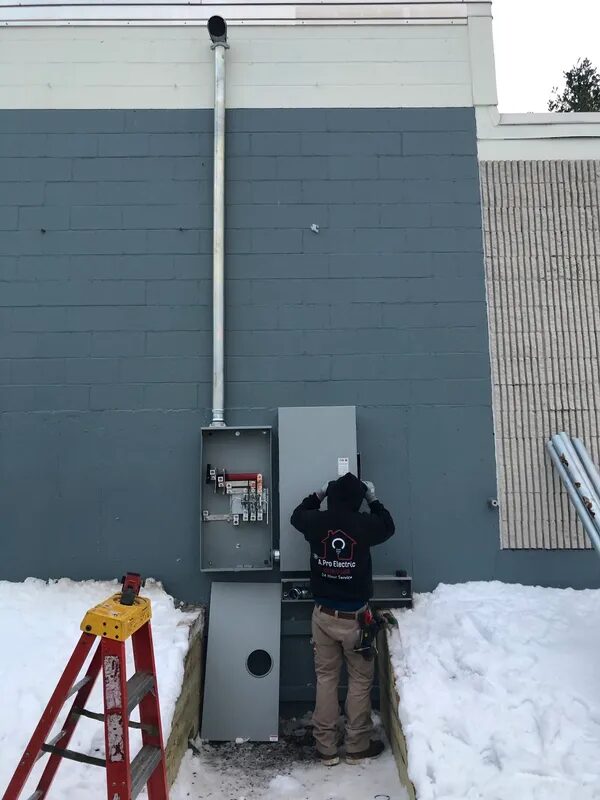
24 Hour Emergency Electrician in New Hampshire
Power loss, burning smells, scorched panels, breakers that will not reset and storm damage to a mast or service, answered around the clock across Manchester, Concord, Nashua, Derry, Salem and the towns around them.
What Counts as an Electrical Emergency in a New Hampshire Home
What Counts as an Electrical Emergency
An electrical emergency is anything where waiting makes it worse, and that is a shorter and clearer list than most people assume.
Call immediately for a burning or hot-plastic smell anywhere, scorch marks or discoloration on an outlet, a switch or the panel, anything warm to the touch that should not be, buzzing or crackling, a breaker that will not reset, water reaching electrical equipment, or anybody feeling a shock or a tingle from an appliance or a faucet.
None of those is a nuisance. They are heat or arcing problems, and heat at a termination is how electrical fires start. Switch off what you safely can at the panel, leave it off, and call. Do not reset a breaker to see what happens.
We answer emergency work around the clock across Manchester, Concord, Nashua, Derry, Salem, Bedford, Henniker, Laconia and Keene, and the honest answer on the phone is sometimes that you should call whoever is nearest rather than wait for us.
What Can Safely Wait Until Morning
Plenty, and saying so is more useful than treating everything as urgent, because a genuine emergency deserves to be recognized as one.
A single breaker tripping when several heavy things are on at once is an overload, which is a usage problem with a free fix. A light fixture that has stopped working. An outlet that never worked since you moved in. A panel with no spare spaces. A GFCI that trips occasionally in an outdoor box after rain.
Those are all worth booking rather than calling out at midnight, and booking them costs less. Our guide to why breakers trip separates the cases, and the breaker triage tool asks four questions and tells you plainly which one you have.
The one qualifier is that if something worries you more than the list does, trust yourself and call. Nobody has ever been criticized here for ringing about a smell.
What to Do Before an Electrician Arrives
Make it safe, make it accessible, and stop making it worse, in that order.
If you can identify the circuit, switch it off at the panel and leave it off. If the problem is at the panel itself, or you cannot tell, switch off the main if it is safe to reach and you are confident doing it. Do not stand in water to reach anything.
Unplug what was running on the circuit, particularly anything with a heating element, since a failing appliance is a common cause and leaving it connected keeps the fault live.
Then the practical part, which saves real time on arrival. Clear access to the panel. Find a flashlight. Note what was running when it happened and what you have already tried, because that is genuinely the most useful information anybody can give us on the phone.
Partial Power Loss and What Causes It
Losing half the house rather than all of it is a specific symptom with a short list of causes, and it is worth knowing because it often looks worse than it is.
A house is fed by two legs of 240 volt service split into 120 volt circuits. Losing one leg takes out roughly half the circuits while the rest keep working, which is why lights work in one part of the house and not another and why the electric range behaves oddly.
The causes are a tripped main or a failed breaker, a loose or burnt connection at the panel or the meter socket, damage to the service entrance or the mast, or a fault on the utility side. The last one is theirs rather than ours, and the quickest check is whether the neighbors have power.
What makes it urgent rather than inconvenient is that several of those causes involve a connection that is already getting hot. A partial outage with any smell or warmth is not something to wait on.
Storm Damage to a Mast or Service Entrance
A downed service is a divided job, and knowing the division saves days of waiting for the wrong people.
The utility owns the supply up to the point of attachment. The property owner owns the mast, the weatherhead, the service entrance conductors and the meter socket. When a limb takes the whole assembly off the side of a house, which happens across New Hampshire every winter, the utility disconnects and will not reconnect until the customer-owned part has been repaired and inspected.
That is our part, and it is why the sequence is call the utility for safety, then an electrician for the repair, then the utility again to reconnect after inspection. Getting that order wrong is the most common reason a house sits without power longer than it needed to.
Mast and service entrance repair is the same work as a service upgrade, done under time pressure, and it is frequently the moment a 100 amp service becomes a 200 amp one because the work is already open.
Breakers That Trip Repeatedly
Four different things trip breakers and they behave differently, and telling them apart is most of the diagnosis rather than a preliminary to it.
An overload is slow, happens with several things on, and usually trips a minute or two after the last one was switched on. A short circuit is instant and often loud. A ground fault is current escaping to earth, which is what a GFCI watches for and why it trips at a few thousandths of an amp. An arc fault is the signature of a damaged cable or a loose connection, which is what an AFCI listens for.
A breaker that trips the instant it is reset with nothing switched on is reporting a fault rather than a load, and it should be left off.
What is never the answer is a bigger breaker. The breaker protects the wire rather than the appliance, and raising it means the wire can run hot enough to start a fire before anything notices. If a circuit genuinely cannot carry what you need, the fix is another circuit.
After-Hours Callouts and What They Cost
After-hours work is charged differently from booked work, and it is worth understanding the shape of it rather than being surprised by it.
The variables are the time of day, the day of the week, and what the job turns out to be. A callout that resolves in an hour is a different bill from one that involves a service repair at two in the morning in a storm, and the honest position is that neither can be quoted precisely over the phone before anybody has seen it.
What we will do is tell you on the call whether it sounds like something that should be dealt with now or something that can wait until morning at normal rates, because those are genuinely different answers and the second one saves you money.
Where the same fault keeps recurring, the cheapest outcome is usually a diagnosis visit in daylight rather than repeated emergency callouts that each stabilise it without finding the cause.
Preventing the Emergencies That Give Warning
Most of them give warning, and the warnings are boring rather than dramatic, which is why they get ignored.
A breaker that has started tripping more often than it used to. An outlet or switch plate that is warm or discolored. A faint smell you noticed once and did not smell again. Lights dimming when something starts. A panel nobody has opened in twenty years. Each of those is a slow signal and each is cheap to investigate.
The structural preventions are the same short list. A panel that is sound and correctly labeled. GFCI and AFCI protection where current requirements call for it. Enough circuits for how the house is actually used, so nothing runs permanently near its limit. Surge protection at the panel, which matters in a state with this much storm activity.
An electrical safety inspection finds the slow signals in an hour, and it is the cheapest hour anybody spends on a house they already own.
What Emergency Work Covers
- Total and partial power loss
- Burning smells and scorched outlets, switches or panels
- Breakers that will not reset, or trip immediately
- Storm damage to a mast, weatherhead or service entrance
- Water reaching electrical equipment
- Shocks or tingles from an appliance, a faucet or a fixture
- Making safe and isolating, then a proper repair
- Coordination with the utility on anything on their side
- Temporary arrangements where a full repair has to wait for daylight
Call Right Away If
- You can smell burning or hot plastic
- Anything at the panel is warm, scorched or discolored
- There is buzzing, crackling or visible arcing
- A breaker will not reset, or trips again instantly
- Water has reached a panel, an outlet or a fixture
- Somebody has felt a shock or a tingle
- A limb has pulled the service off the house
- Half the house has lost power with no obvious cause
24 Hour Emergency Questions, Answered
Do You Answer Calls at Night and at Weekends?
Yes, emergency work is answered around the clock. What varies is how quickly somebody reaches you, which depends on where you are. Close in that is a short drive; at the edges of the area it is longer, and we will tell you that on the phone rather than after you have waited.
Is It Safe to Reset a Breaker Myself?
Once, to see whether it was a one-off, is reasonable. Repeatedly is not, because each reset puts the fault back under power. If there is any smell, warmth, scorching or buzzing, do not reset it at all. Leave it off and call.
The Power Is Out. Is It Me or the Utility?
The quickest check is whether the neighbors have power and whether the outage is total or partial. A whole street out is the utility. Half your house out with the neighbors fine is almost certainly on your side, and that is the one worth calling about.
Who Repairs the Mast After a Storm?
The utility owns the supply to the point of attachment, and the property owner owns the mast, weatherhead, service entrance conductors and meter socket. The utility will not reconnect until the customer-owned part is repaired and inspected, which is our part.
Should I Turn Off the Main Breaker?
If the problem is at the panel or you cannot identify the circuit, and you can reach the main safely and are confident doing it, yes. Never stand in water to reach anything, and if you are not comfortable with it, leave it and say so when you call.
What Information Helps Most on the Call?
What you can smell, see or hear, what was running when it started, what you have already tried, and whether the neighbors have power. That is genuinely the most useful thing anybody gives us, because it often decides whether this is tonight or tomorrow morning.
Guides on 24 Hour Emergency
How to Tell If Your Electrical Panel Needs Replacing
The signs worth acting on, the panel brands insurers flag, and how to tell a full panel from an unsafe one.
Standby Generators: What They Cover and What They Do Not
Whole-house against essential circuits, automatic against manual, and what a transfer switch is for.
Why Breakers Trip, and What It Means
The difference between an overload, a short and a ground fault, and which of them is urgent.
Other Residential Electrical Work
Electrical Panels & Service
Panel replacements, service upgrades, meter and mast work.
Wiring & Rewiring
Whole-house rewiring, knob and tube removal, added circuits.
Lighting
Recessed lighting, fixtures, exterior and landscape lighting.
EV Charger Installation
Level 2 chargers, 240 volt outlets, service capacity for an EV.
Generators & Backup Power
Transfer switches, standby generator wiring, portable inlets.
Remodels & Additions
Kitchens, bathrooms, basements, additions and new builds.
Appliance & Specialty Circuits
Hot tubs, well pumps, ranges, dryers and heat pump circuits.
Safety, Inspections & Repairs
Safety inspections, code corrections, surge and detector work.