

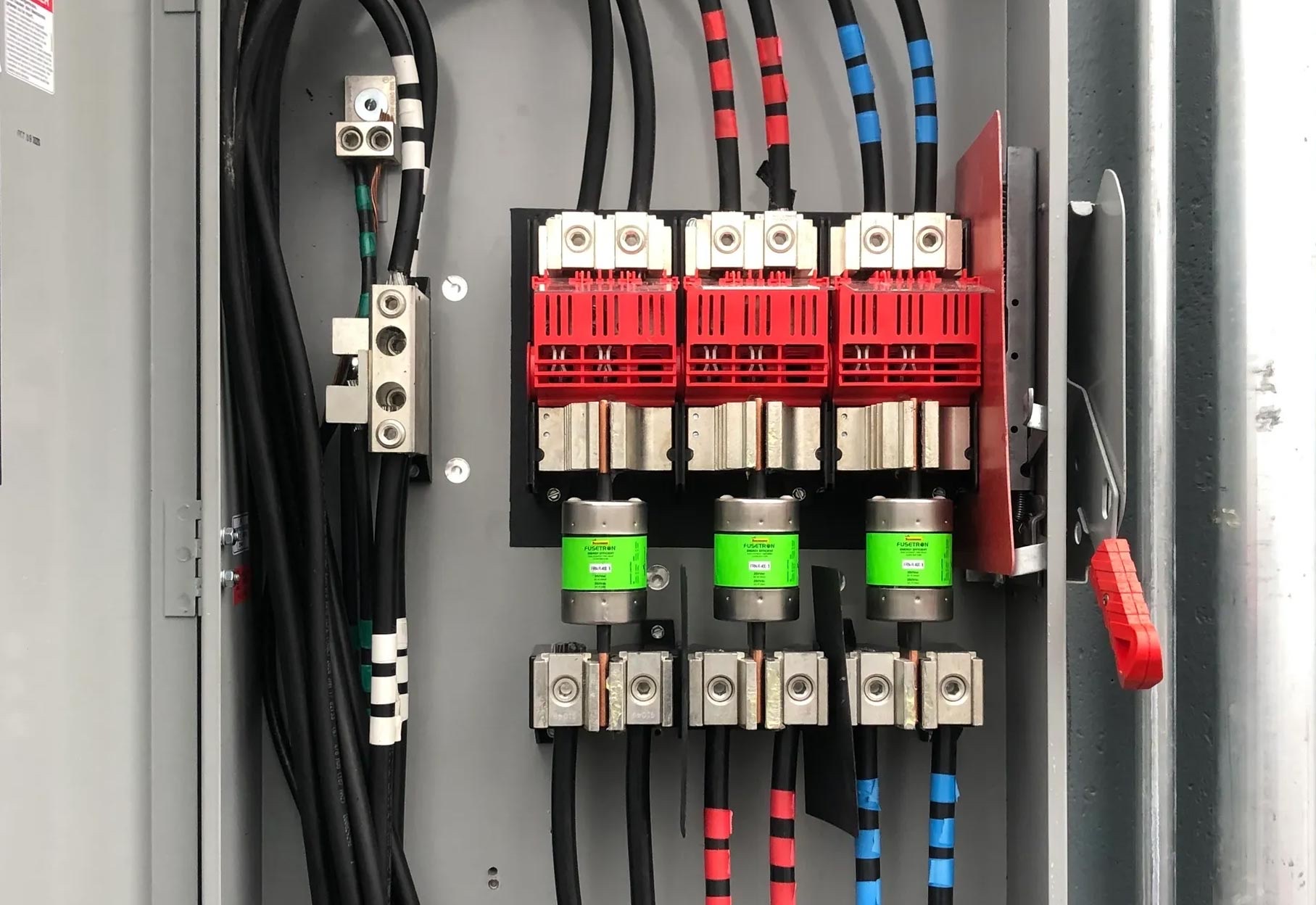
Commercial Electrical Maintenance Contracts in NH and Massachusetts
Planned electrical maintenance for commercial and industrial buildings: thermal surveys, panel inspections, emergency lighting testing and generator servicing, across Manchester, Nashua, Concord, Portsmouth, Dover, Keene and the Merrimack Valley.
Scheduled Electrical Maintenance for Commercial Buildings and Sites
What a Commercial Maintenance Arrangement Covers
A scheduled visit, on a known interval, that inspects and tests the electrical infrastructure a building depends on and reports what was found, so problems are dealt with on a plan rather than at the moment they stop the business.
A typical scope covers a thermal survey of panels and distribution under load, visual inspection and torque checks at terminations, emergency and exit lighting testing, generator exercise and service, and a written record of the condition and anything that needs attention.
We run these arrangements across southern New Hampshire and northern Massachusetts: manufacturers and warehousing around Manchester, Hooksett and Bedford, offices and light industrial in Nashua, Merrimack and Concord, the Seacoast at Pease, Newington, Portsmouth, Dover and Rochester, Keene to the west, and over the border at Lowell, Lawrence, Haverhill, Methuen and Andover.
Both states are licensed, so a business with sites either side of the line runs one arrangement rather than two, and the service area page sets out how far that reaches. Managed residential portfolios run the same way under property management work.
Thermal Imaging and What It Finds
Thermal imaging is the single most useful tool in commercial electrical maintenance, because the failure mode it detects is the one that causes most unplanned outages and most electrical fires.
A connection that is loose, corroded or undersized has resistance, resistance under load produces heat, and heat accelerates the deterioration. The process is gradual and entirely invisible until the point of failure. A thermal camera sees it months in advance, as a bright spot on a lug, a breaker or a termination that should be the same temperature as everything around it.
The survey has to be done under load to be meaningful. A panel scanned on a quiet Sunday shows nothing, because nothing is drawing current. That constrains when it can be done and it is the reason the survey is scheduled around the building's operation rather than around the contractor's.
Our guide to what preventive maintenance actually prevents covers what a typical survey turns up and what it is worth against the cost of the failure it avoids.
Panel Inspection, Terminations and Torque
Most of what a thermal survey finds resolves to a connection, and connections are what the physical inspection addresses directly.
Terminations loosen over time through thermal cycling: they heat under load, cool when the load drops, and expand and contract with it. Aluminum conductors move more than copper, and older aluminum terminations are a known maintenance item rather than a fault.
Manufacturers specify torque values for terminations and they exist for a reason. Under-tightened is a hot connection; over-tightened damages the conductor and produces the same result by a different route. Checking them to specification is unglamorous and it is one of the highest-value things done on a maintenance visit.
The inspection also covers the things that only get noticed when somebody is looking: corrosion, water ingress, missing blanks and covers, obstructions in front of gear, and panel schedules that no longer describe what is on the circuits.
Emergency Lighting and Life Safety Testing
This is a compliance obligation in commercial buildings, and it is the item most often found never to have been done at all.
Emergency and exit lighting requires periodic function testing and a longer duration test to confirm the batteries genuinely carry the required run time, with records kept. Batteries degrade quietly, and a unit whose indicator light is on may still fail within a minute of losing supply.
A building that has never tested its emergency lighting is usually one where a proportion of the units do not work, and that is only discovered during an inspection or during an actual evacuation. Neither is a good time. Where the fittings themselves are at end of life, it turns into a lighting replacement rather than a test.
Folding it into a scheduled visit means it gets done, gets recorded and gets remedied, rather than sitting on a list nobody owns. The same applies to generator exercise and load testing, covered under commercial standby power.
Generator and Standby System Servicing
A standby generator is the piece of equipment most likely to be assumed working and least likely to be checked.
Servicing covers the manufacturer schedule on oil, filters, coolant and belts, and the items that actually cause failures to start: the battery above all, fuel condition, and the controller. Battery failure is the most common single reason a standby unit does not start when it is needed, and it gives no warning.
Exercise runs prove the engine starts. A load test proves the system does its job, which is a different and more useful statement. Running at no load for fifteen minutes a week demonstrates very little about whether the unit will carry the building.
Where the generator serves a life safety function, testing and record keeping requirements may apply in their own right, and those records are the ones an inspector asks for.
Building the Right Scope and Interval
There is no single correct arrangement, and the useful version is built from what the building actually is rather than from a template.
Interval follows criticality and environment. A clean office with modern gear may need an annual visit. A manufacturing plant with heavy cycling loads, a food production environment, or a building with aging distribution justifies more frequent attention. Dusty, damp and corrosive environments age equipment considerably faster than the nameplate life suggests.
Scope follows risk. A building whose exposure is an outage focuses on distribution and standby power. One whose exposure is compliance focuses on emergency lighting and records. Most buildings need some of both, weighted rather than equal.
The honest version of this is that a maintenance arrangement should be built around what would actually hurt if it failed, and we would rather scope it that way than sell a standard package that inspects things nobody is worried about.
Reporting and Acting on What Is Found
A maintenance visit that produces no usable record is most of the cost with none of the value.
The report says what was inspected, what was found, what was corrected on the visit and what needs scheduling, with the last group prioritized honestly. Something at risk of imminent failure is a different item from something that will need attention within a few years, and presenting both at the same urgency helps nobody.
Over several visits the record becomes more useful than any single survey, because it shows what is changing. A connection that was slightly warm last year and warmer this year is a trend rather than a reading, and trends are what allow work to be planned rather than reacted to.
For a manager or owner, that record is also the evidence that the building has been maintained, which matters for insurance and for anyone doing due diligence on the property.
What Maintenance Costs Against What Failure Costs
The argument for planned maintenance is not that it is cheap. It is that the alternative is priced by the failure rather than by the work.
An unplanned outage in a commercial building carries the electrical repair plus the lost trading, the spoiled stock, the interrupted production and the out-of-hours rate for all of it. The same fault found on a scheduled visit is a tightened connection or a replaced breaker done during normal hours.
The failures that maintenance prevents are also the ones most likely to be severe. An electrical fire, a damaged switchboard or a distribution failure are not proportional events; they are step changes in cost and in disruption.
Where a building has a history of emergency call-outs, that history is usually the argument by itself. Recurring call-outs are a symptom of infrastructure that needs planned attention, and continuing to pay for them at emergency rates is the most expensive way to maintain a building.
What a Scheduled Maintenance Visit Covers
- Thermal survey of panels, distribution and terminations under load
- Visual inspection of gear, enclosures and clearances
- Termination checks to manufacturer torque specification
- Breaker condition and operation
- Emergency and exit lighting function and duration testing
- Generator exercise, servicing and load testing
- Panel schedule and labeling brought back up to date
- Written report with findings prioritized honestly
- Corrective work done on the visit where practical
- A record that builds into a trend over successive visits
Signs a Commercial Building Needs Planned Maintenance
- More than one emergency call-out in the past couple of years
- A panel or breaker that runs warm
- Emergency lighting that has never been tested or recorded
- A standby generator that has never been load tested
- Distribution gear over about thirty years old
- A dusty, damp or corrosive operating environment
- Panel schedules that no longer match the circuits
- An insurer or auditor asking for maintenance records
- Production or trading that cannot absorb an unplanned outage
Maintenance & Service Contracts Questions, Answered
How Often Should Commercial Electrical Maintenance Be Done?
It depends on the building. A clean office with modern gear may justify an annual visit; a manufacturing plant with heavy cycling loads or a building with aging distribution justifies more. Environment matters as much as age, because dust, damp and corrosion age equipment faster than time alone.
What Does Thermal Imaging Actually Find?
Connections that are loose, corroded or undersized, which run hot under load and get worse on their own. That is the failure mode behind most unplanned outages and most electrical fires, and it is invisible until it fails. A thermal camera sees it months ahead.
Does the Survey Need the Building Running?
Yes. Thermal imaging under no load shows nothing useful, because heat only appears where current is flowing. The survey is scheduled around the building being in normal operation, which is the opposite of how most electrical work is scheduled.
Is Emergency Lighting Testing a Legal Requirement?
Commercial buildings are required to have functioning emergency and exit lighting, with periodic function and duration testing and records kept. It is one of the items most often found never to have been done, and it is straightforward to fold into a scheduled visit.
Can Maintenance Be Done Without Interrupting the Business?
Most of it, yes. Thermal surveys are done with the building running, which is what makes them meaningful. Work requiring gear to be isolated, such as torque checks inside a panel, gets scheduled into an agreed window.
Do You Cover Multiple Sites Under One Arrangement?
Yes, and it is usually easier for everyone than treating each building as a separate job. With licenses in both New Hampshire and Massachusetts, a portfolio that straddles the border is one arrangement rather than two contractors.
What Do We Get at the End of a Visit?
A written report: what was inspected, what was found, what was corrected on the visit, and what needs scheduling, with urgency stated honestly. Over successive visits that record shows trends, which is what allows work to be planned instead of reacted to.
Guides on Maintenance & Service Contracts
LED Retrofit: Working Out the Payback
Fixture count, running hours and rate, and how to tell a real payback figure from a sales one.
What a Standby Generator Protects in a Business
Working out what an hour of downtime costs, and sizing backup against that rather than against the building.
Preventive Maintenance: What It Actually Prevents
Thermal scanning, torque checks and what a loose connection looks like before it becomes an outage.
Other Commercial Electrical Work
Tenant Fit-Ups & Build-Outs
Restaurants, retail, offices and warehouses, rough-in to trim.
Service, Distribution & Switchgear
Three-phase service, panelboards, transformers and feeders.
Commercial Wiring & Circuits
New build wiring, retrofits, added circuits, conduit and raceway.
Commercial Lighting
LED retrofits, parking lot and site lighting, controls, high-bay.
Low Voltage & Systems
Data cabling, intercom, surveillance and access control.
24 Hour Commercial Emergency
Downtime response, storm and outage work, temporary power.
Property Management & Multi-Family
Common areas, apartment buildings, turnovers, house panels.
Equipment & Machine Connections
Kitchen equipment, motors, rooftop units and process circuits.
Commercial Generators & Emergency Power
Standby systems, automatic transfer switches, life safety power.
Commercial EV & Fleet Charging
Workplace charging, fleet charging, multi-port installations.
New Construction & GC Work
Ground-up commercial, design-build, subcontracting to GCs.