

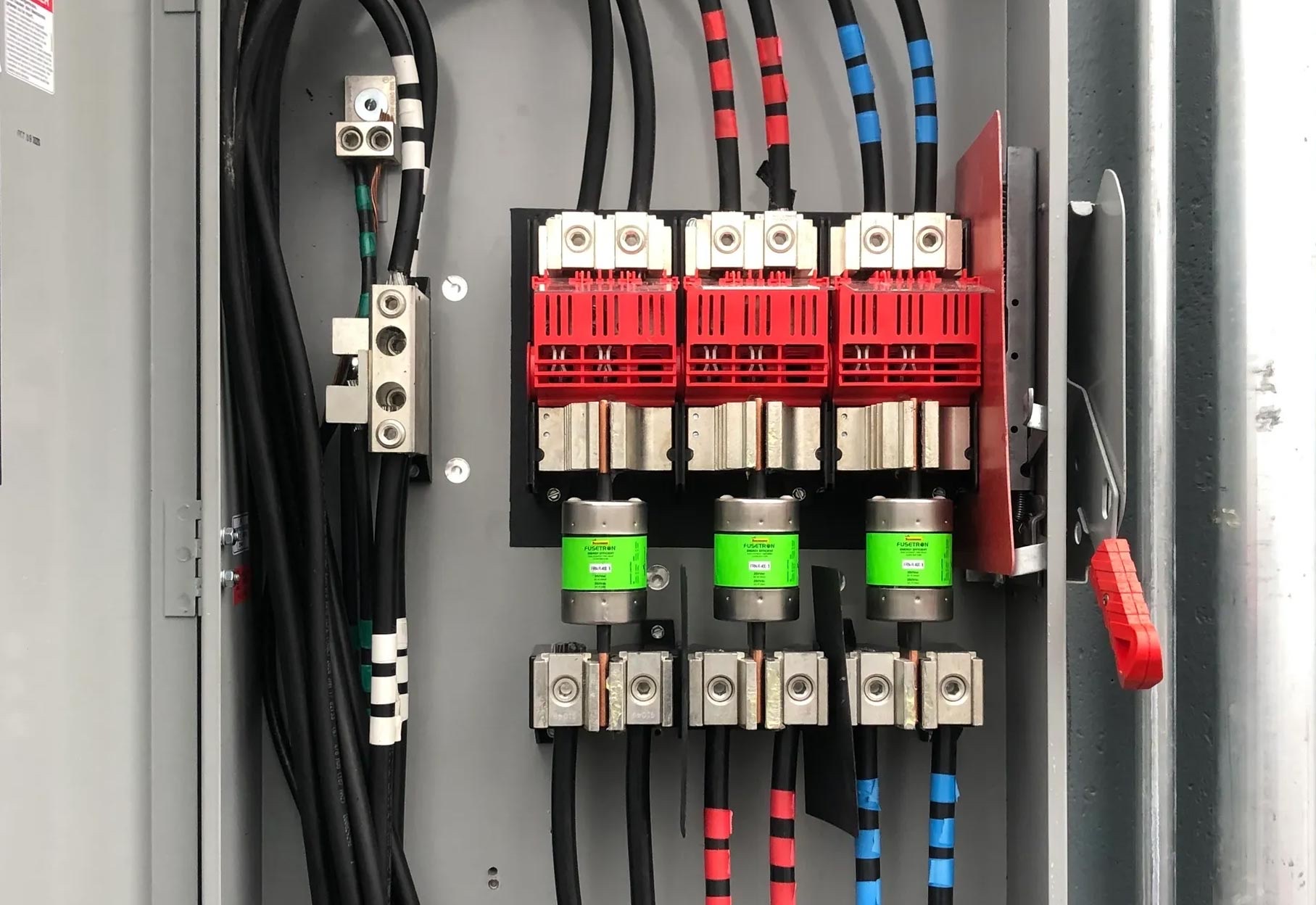
Commercial Electrical Service, Distribution and Switchgear in NH and MA
The incoming supply, the gear it lands in and everything downstream of it, for commercial and industrial buildings across Manchester, Nashua, Concord, Portsmouth, Dover and the Merrimack Valley towns over the Massachusetts line.
Service, Distribution and Switchgear Work for Commercial Buildings
What Commercial Service and Distribution Work Covers
Everything from the utility connection to the panelboards that feed the building: the service entrance, the metering, the main gear, the transformers, the feeders and the distribution panels the branch circuits come off.
It is the least visible work in a building and the work everything else depends on. A fit-up, a new production line, an EV array or a commercial kitchen are all limited by what the service and the distribution can carry, which is why this is frequently the first question rather than the last.
We do this work across the industrial and commercial corridors of the region: the Manchester millyard and the Route 293 belt, the Daniel Webster Highway and the Everett Turnpike corridor through Nashua and Merrimack, the Route 106 and Loudon Road area in Concord, Pease International Tradeport and the Newington industrial area on the Seacoast, the I-93 corridor through Salem, Derry and Londonderry, and over the state line into Lowell, Lawrence, Haverhill, Methuen, Andover and Tewksbury.
Both New Hampshire and Massachusetts are covered under separate licenses held by the same master electrician, which on the border is the difference between one contractor and two.
When a Commercial Building Needs a Service Upgrade
Almost always because something new will not fit, rather than because the existing service has failed.
A tenant arrives with equipment the building was never sized for. A kitchen goes into a unit that was offices. A landlord adds EV charging to the lot. A manufacturer adds a machine. Or the gear is old enough that parts are no longer made and a single failed breaker becomes a distribution problem.
The starting point is a load calculation against what the building actually draws, measured where possible rather than assumed, and against what it is about to draw. Existing commercial buildings frequently have more headroom than the panel schedule suggests, because loads listed on paper were removed years ago and never crossed off.
Sometimes the answer is that the service is adequate and the problem is distribution: a full panel, an undersized feeder, or a sub-panel in the wrong place. That is a much smaller job, and it is worth establishing before anyone quotes a new service.
Three-Phase Power and What Actually Needs It
Three phase is what most commercial equipment of any size expects, and whether a building has it is the first thing to find out rather than the last.
Motors run more efficiently on it, and much commercial kitchen, HVAC, machine shop and production equipment is only made in three-phase versions. A building with single-phase service and a tenant bringing three-phase equipment has a real problem, and it is one that is much cheaper to discover before the lease is signed.
What is available depends on the street. In the built-up commercial areas of Manchester, Nashua, Portsmouth, Lowell and Lawrence three phase is usually there or close. On a rural stretch or a converted building outside a commercial corridor it frequently is not, and bringing it in is a utility project with a lead time measured in weeks or months.
Our guide to three-phase power and when a business needs it covers how to find out what a building already has, and what the options are when the answer is that it does not.
Switchgear, Panelboards and Distribution Equipment
The gear itself is a long-lead item and it is the part of a project most likely to set the date.
Switchgear, switchboards, panelboards, transformers and the larger breakers are ordered rather than stocked, and lead times on commercial gear have been long and unpredictable for several years. A project planned around a four-week delivery that turns into sixteen is a project that has slipped a quarter.
That is the argument for getting the electrical scope settled early even when the rest of the design is still moving. The gear can be ordered against a known load long before the finishes are chosen.
Where existing gear is being replaced rather than added to, matching matters: bus ratings, breaker types and whether replacement breakers for an obsolete panelboard can still be sourced at all. An obsolete distribution panel that nobody can buy a breaker for is functionally at end of life even while it is still working.
Feeders, Sub-Panels and Getting Power Where It Is Needed
A great deal of commercial work is not about the service at all. It is about getting adequate capacity to the part of the building that needs it.
A sub-panel and a feeder to a new production area, a tenant unit, a kitchen or a mezzanine is usually the right answer once more than two or three circuits are involved. It is cheaper than running individual circuits the length of a building, it leaves capacity for the next thing, and it puts a local disconnect where the work is.
Feeder sizing is where corners get cut and it is the wrong place for it. Voltage drop over a long run in a large building is a real effect, and a feeder sized only to the connected load rather than to the distance produces equipment that runs hot and controls that behave oddly.
Routing is the other half. In a mill conversion or an occupied building the route is frequently the constraint rather than the cable, and it is worth walking before it is priced.
Coordinating the Utility and the Shutdown
Any work on the service side involves the utility, and their schedule is usually what sets the real date.
A new service, a service upgrade, a meter relocation or a cutover needs the utility to disconnect and reconnect, and that is booked rather than arranged on the day. On a larger job it may also involve their engineering, a new transformer or work in the street, all of which have their own timescales.
We get the utility engaged at the start of a project rather than after the gear is ordered, because that sequence is what causes the delays people blame on the contractor.
The shutdown itself gets planned around the business. Cutovers happen out of hours, at weekends, or in phases so only part of a building is down at a time, and keeping a business open during electrical work covers how those windows are found. For a building that genuinely cannot lose power, temporary supply or a phased cutover is the answer rather than a longer outage.
Service Work in Older and Converted Buildings
The commercial building stock in this region is old, and a large share of it is doing a different job than it was built for.
The mill buildings in Manchester, Lowell, Lawrence and Nashua, the brick blocks in Concord and Dover, the converted industrial space around the Seacoast: these frequently carry decades of accumulated distribution, added a tenant at a time, with abandoned feeders, panels fed from other panels, and no coherent record of any of it.
The work in a building like that starts with establishing what is actually there and what is live. That is not a formality. It is normal to find panels nobody can identify the source of, and it is not safe to work around them on assumption.
What frequently comes out of it is a rationalization rather than an upgrade: consolidating distribution, removing what is dead, and getting the building to a state where the next tenant fit-up is a straightforward job instead of an investigation.
Metering, Sub-Metering and Multi-Tenant Buildings
Who pays for what is an electrical question in any building with more than one occupant, and it gets decided by how the distribution is arranged.
Each tenant metered separately by the utility is the cleanest arrangement and the one landlords generally want. It is not always what exists: buildings subdivided after they were built frequently have one meter, a house panel and an informal split, which means common area loads and tenant loads are mixed and the landlord is paying for something.
Sub-metering is the usual retrofit answer where separate utility meters are not practical, and it needs the distribution rearranged so that each tenant's load is genuinely on its own feeder before anything can be measured.
Our guide to electrical in multi-tenant and mixed-use buildings covers the arrangements, and property management and multi-family work is the ongoing side of it. Where the building is being re-tenanted, the fit-up is usually when the metering gets fixed.
What Service and Switchgear Work Usually Covers
- Load assessment against measured demand, not the original design
- New and upgraded commercial services, single and three phase
- Service entrance, metering and utility coordination
- Switchgear, switchboards and panelboard supply and installation
- Transformers, including dry type for indoor commercial spaces
- Feeders and sub-panels to tenant units, kitchens and production areas
- Replacing obsolete distribution gear where breakers can no longer be sourced
- Sub-metering and separating tenant loads from house loads
- Phased cutovers and out-of-hours shutdowns
- Permit under a master license in New Hampshire or Massachusetts
Signs a Commercial Building Needs Distribution Work
- A new tenant or new equipment will not fit on the existing supply
- The main panel is full and there is nowhere to add a circuit
- Breakers for the existing panelboard are no longer manufactured
- Gear is warm, discolored, humming or showing signs of arcing
- Nobody can say what feeds a particular panel
- One meter serves several tenants and the landlord is absorbing the difference
- A three-phase machine is arriving at a single-phase building
- Lights dim or equipment faults when a large motor starts
- An EV array, a kitchen or a production line is being added
Service, Distribution & Switchgear Questions, Answered
How Do I Find Out If My Building Has Three-Phase Power?
Look at the main service and the meter, or at the panel schedule. A three-phase panel has three busbars and breakers in sets of three. If it is unclear, we can establish it on a site visit, and it is worth knowing before equipment is ordered rather than after it arrives.
How Long Does a Commercial Service Upgrade Take?
The physical work is frequently a matter of days. The timeline is set by the utility and by gear lead times, both of which run in weeks or months rather than days. Starting the utility conversation early is what shortens the overall project.
Does the Building Have to Lose Power?
For a cutover, yes, but the question is when rather than whether. It gets scheduled out of hours, at a weekend, or in phases so only part of the building is down at once. For a building that cannot lose supply at all, a temporary feed or a phased approach is the answer.
Can the Existing Panel Just Have a Bigger Main Breaker Fitted?
No. The service conductors, the meter, the gear and the bus all have to be rated for the load, and the utility supply behind them too. A larger breaker on the same equipment removes the protection rather than adding capacity.
What If the Existing Gear Is Obsolete?
If replacement breakers cannot be sourced, the panelboard is effectively at end of life even while it is working, because the next failure cannot be fixed. That is usually the point at which replacing the distribution makes more sense than maintaining it.
Do You Work on the Massachusetts Side of the Border?
Yes. Massachusetts is a separate license from the New Hampshire master license, and we hold both. For an owner with buildings in Lowell, Lawrence, Haverhill or Methuen as well as southern New Hampshire, that is one contractor across the portfolio.
Can You Separate Tenants Onto Their Own Meters?
Frequently, though it depends on how the building is fed and what the utility will do there. The electrical work is rearranging the distribution so each tenant genuinely has their own feeder, which has to happen before any metering arrangement can measure anything meaningful.
Guides on Service, Distribution & Switchgear
Planning the Electrical for a Restaurant Fit-Up
Kitchen equipment loads, the inspection sequence, and the decisions that are expensive to change late.
Three-Phase Power: What It Is and When a Business Needs It
Why some equipment will not run on single phase, and what bringing three phase into a building involves.
Keeping a Business Open During Electrical Work
What genuinely cannot be done live, how work gets phased, and why the schedule is the real cost.
Other Commercial Electrical Work
Tenant Fit-Ups & Build-Outs
Restaurants, retail, offices and warehouses, rough-in to trim.
Commercial Wiring & Circuits
New build wiring, retrofits, added circuits, conduit and raceway.
Commercial Lighting
LED retrofits, parking lot and site lighting, controls, high-bay.
Low Voltage & Systems
Data cabling, intercom, surveillance and access control.
Maintenance & Service Contracts
Scheduled maintenance, thermal scanning, planned replacement.
24 Hour Commercial Emergency
Downtime response, storm and outage work, temporary power.
Property Management & Multi-Family
Common areas, apartment buildings, turnovers, house panels.
Equipment & Machine Connections
Kitchen equipment, motors, rooftop units and process circuits.
Commercial Generators & Emergency Power
Standby systems, automatic transfer switches, life safety power.
Commercial EV & Fleet Charging
Workplace charging, fleet charging, multi-port installations.
New Construction & GC Work
Ground-up commercial, design-build, subcontracting to GCs.