

Three-Phase Power: What It Is and When a Business Needs It
What three-phase is, which equipment genuinely needs it, and how to find out what a commercial building in the mill cities already has.
Published
What Three-Phase Power Is and When a Business Needs It
What Is Three-Phase Power and How Is It Different?
Three-phase power is how nearly every commercial and industrial building in New Hampshire and northern Massachusetts is supplied, and the difference from the single-phase in a house is not simply that there is more of it.
Single-phase delivers power in one alternating wave, which rises and falls and passes through zero a hundred and twenty times a second. Three-phase delivers three of those waves offset from each other, so as one is falling another is rising and the delivery never drops to nothing. For anything with a motor that is transformative, because the torque is smooth and constant rather than pulsed, which is why three-phase motors are smaller, cooler, longer-lived and more efficient than single-phase motors doing the same work.
It also carries more power on less copper. Three conductors sharing the load deliver considerably more than a single-phase supply of the same wire size, which is why the distribution inside a large building is three-phase even where the individual circuits are not.
In practice a commercial building takes a three-phase service and splits it. The heavy equipment runs on three-phase; the lighting and outlets run on single-phase circuits derived from it.
It is a live question in every commercial district we work in, from the Manchester Millyard and the industrial parks around Nashua and Hudson, to Pease International Tradeport on the Seacoast, to the Massachusetts mill cities of Lowell, Lawrence and Haverhill.
When Does a Business Actually Need Three-Phase Power?
When the equipment requires it, which is a shorter and harder rule than most of the advice on the subject suggests. There is no benefit in three-phase for a business that does not have equipment asking for it.
What asks for it is consistent. Commercial kitchen equipment, particularly combi ovens and larger fryers. Rooftop HVAC units of any size. Air compressors. Machine tools and anything in light manufacturing. Elevators. Large refrigeration. Commercial laundry. Pumps above a modest size. Anything in a warehouse that moves. Each of those arrives as a dedicated equipment connection sized from its nameplate.
The distinguishing feature is usually a motor with real work to do. A business that is offices, retail, a small café or a clinic frequently runs perfectly well on single-phase and gains nothing from converting.
Where it becomes urgent is a change of use. A retail unit becoming a restaurant fit-up, an office becoming a clinic with imaging equipment, or a warehouse taking on light manufacturing all bring three-phase equipment into a building that may never have had it.
How Do You Know If a Building Already Has Three-Phase?
Sometimes by looking, sometimes only by testing, and the answer is frequently more complicated than yes or no in older commercial stock.
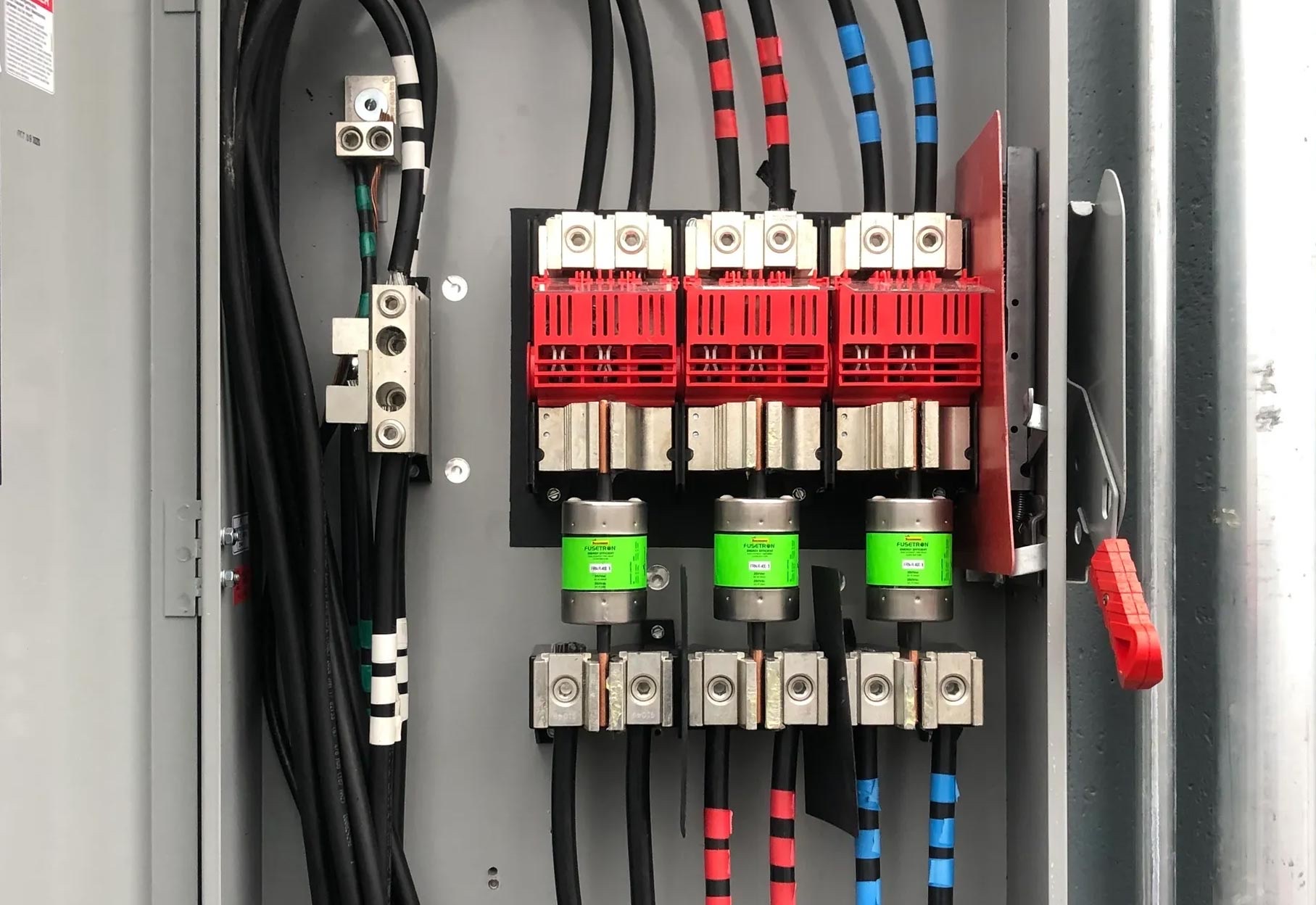
At the panel, a three-phase service typically shows three hot conductors landing on the main rather than two, and the panel board has three busbars rather than two. The main breaker is usually marked with the voltage and the phase. Outside, the service drop or lateral has more conductors. Three-phase panels are commonly labeled 120/208 volt or 277/480 volt, where single-phase commercial is generally 120/240.
What complicates it is partial supply, and the mill cities are full of examples. A converted floor in Lowell, Lawrence, Haverhill or the Manchester Millyard may have three-phase to the building and single-phase to your unit, or three-phase serving one end of a floor because a previous tenant paid for it and nothing at the other. Pease International Tradeport and the industrial parks around Methuen, Andover and Nashua are more consistent, since they were built for it.
The reliable answer is somebody looking at the service, the meter and the panel together. It is a short visit and it is the difference between a fit-up that is priced correctly and one that is not.
What Does It Cost to Bring Three-Phase Into a Building?
It is decided almost entirely by what is already at the street, and that makes it one of the few electrical questions where the honest answer really is that it depends on the address.
If three-phase distribution already runs past the building, bringing it in is a service upgrade, meaning a new lateral or drop, a new meter arrangement, new service entrance conductors and a new panel or switchboard. Substantial, predictable, and mostly within our control.
If it does not run past the building, the utility has to extend it, and that is a different order of magnitude in both cost and time. In an established industrial park or a mill district it is usually there. On the edge of a town, or on a rural commercial property, it may not be, and the extension can be the single largest number on the project.
Either way the utility is in the critical path, and their lead time frequently sets the schedule for everything else. Commercial service upgrades and three-phase service are started early for that reason rather than fitted in around the rest of the job. The practical advice is the same as for any fit-up. Establish it before signing rather than after, because it is a question about the building rather than about your business, and it does not change once you are in.
Can You Run Three-Phase Equipment on a Single-Phase Supply?
There are ways, and they are compromises rather than solutions. It is worth knowing what they are so the decision is informed rather than sold.
A phase converter, either rotary or static, generates an approximation of three-phase from a single-phase supply. Rotary converters are the better of the two and they genuinely work for some applications. A variable frequency drive can take single-phase in and produce three-phase out for one motor, and for a single machine that is often the neatest answer of all.
What both share is that they are per-machine or per-installation workarounds with their own losses, their own noise and their own failure modes. The power they produce is not as clean as a utility supply, which matters for electronics and for anything with sensitive controls. Warranties are sometimes affected. They also do not scale. One machine on a VFD is sensible, a whole kitchen on a converter is not.
The rule of thumb is that a converter suits one piece of equipment in a building that will never need more. Where several machines are involved, the circuits and distribution behind them are usually the better investment. Where the business is growing into three-phase, a real service is cheaper than a series of workarounds bought one at a time.
What Voltage Should a Commercial Building Have?
Most commercial buildings in the region run at one of two arrangements, and which one you have changes what equipment fits and what it costs to run.
120/208 volt three-phase is the common arrangement in smaller commercial buildings, restaurants, retail and converted space. It gives 120 volts for ordinary circuits and 208 for three-phase equipment. It is flexible and it suits a building with a lot of ordinary outlets and a moderate amount of equipment.
277/480 volt is the arrangement in larger buildings, warehouses and industrial premises. It gives 480 volts for large motors and 277 for lighting, which is why high-bay lighting in a warehouse is almost always 277 volt. It delivers the same power on smaller conductors, which on a large building is a real saving, and it needs transformers to derive the 120 volt circuits for ordinary outlets.
The mistake worth avoiding is assuming the equipment will match. A tenant moving from a 208 volt unit into a 480 volt building, or the reverse, may find their equipment needs a transformer or does not fit at all. It is worth checking against the equipment list before signing, and it is exactly the kind of thing a look at the switchgear and distribution answers in an afternoon.
Does Three-Phase Power Cost Less to Run?
For the same work, generally yes, and the saving comes from efficiency rather than from a cheaper rate.
A three-phase motor is more efficient than a single-phase motor of the same output, so it draws less for the same job. It also starts more gently and runs cooler, which shows up as longer equipment life and fewer failures rather than as a line on a bill. On a building full of motors, refrigeration and HVAC, that difference compounds.
Commercial tariffs are their own subject and they are where the real money often sits. Many commercial accounts are billed on demand as well as consumption, meaning the highest fifteen or thirty minute peak in a billing period sets a charge that applies whether or not you were near it the rest of the month. Equipment that starts gently rather than abruptly matters to that number, and so does when things start relative to each other.
New Hampshire commercial electricity rates are among the highest in the country, which makes both of those worth more here than they would be elsewhere. It is also why working out a lighting retrofit payback pays back faster in this region than the national figures suggest.
What Should a Business Establish About Three-Phase Power?
Whether the building has it, whether the unit has it, what voltage it is, and whether the equipment you are buying matches. Four questions, one visit, and they are worth answering before a lease or an equipment order rather than after.
The pattern we see repeatedly is a business that signs a space, orders equipment, and then discovers the supply does not support it. In the older commercial buildings across Manchester, Nashua, Keene and the mill districts of Lowell, Lawrence and Haverhill, partial and inconsistent supply within one building is normal rather than unusual, and a floor plan tells you nothing about it.
Where three-phase does have to be brought in, the utility lead time is the number that matters most, and it is the one that can be started earliest.
Three-phase power is a question about the building rather than about the business, which is why it is answered by looking. We assess services, switchgear and distribution across the Seacoast and Pease, Manchester, Nashua, Concord and Keene, and across the border into the Merrimack Valley on the Massachusetts license.
Last updated
Three-Phase Power Questions
Can You Convert a Single-Phase Building to Three-Phase?
Yes, and the cost depends almost entirely on whether three-phase distribution already runs past the building. Where it does it is a service upgrade. Where it does not the utility has to extend it, which is a different order of cost and time.
What Does 120/208 Volt Mean on a Panel?
It is a three-phase service giving 120 volts for ordinary circuits and 208 volts between phases for three-phase equipment. It is the common arrangement in smaller commercial buildings, restaurants and converted space. Larger buildings and warehouses are more often 277/480.
Will My Equipment Run on 208 Volts If It Says 240?
Often not properly, and it is worth checking the nameplate rather than assuming. Equipment rated 240 volt single-phase may run poorly or not at all on 208, and heating elements in particular deliver noticeably less. Many commercial units are dual rated, but that has to be confirmed rather than hoped.
Is Three-Phase Power More Dangerous?
It is higher energy and it demands more of whoever works on it, which is why it is licensed work. For a building occupant it is no more hazardous than any other supply. The difference matters at the switchgear rather than at the outlet.
Do I Need Three-Phase for an Office?
Generally no. An office with ordinary lighting, outlets, IT equipment and a modest HVAC unit runs perfectly well single-phase. It becomes relevant if the building takes on a large rooftop unit, an elevator or a tenant with equipment that requires it.
How Long Does It Take to Get Three-Phase Installed?
The electrical work is measured in days. The utility is measured in weeks or longer, and their lead time usually sets the date for everything else. Starting that conversation first is the single most useful thing on a project that needs it.
The Work Behind This Guide
More Guides for Businesses
Planning the Electrical for a Restaurant Fit-Up
Kitchen equipment loads, the inspection sequence, and the decisions that are expensive to change late.
LED Retrofit: Working Out the Payback
Fixture count, running hours and rate, and how to tell a real payback figure from a sales one.
Keeping a Business Open During Electrical Work
What genuinely cannot be done live, how work gets phased, and why the schedule is the real cost.