

Restaurants, Bars and Breweries
Kitchen equipment loads, bar and cellar power, hood interlocks, and work scheduled around service.
Get a Quote
Most commercial buyers are not shopping for a service, they are looking for somebody who has done their kind of building before. Restaurants and breweries, managed property, retail, offices, clinical space and light industrial, across southern New Hampshire and the Merrimack Valley.
Buildings we have actually worked in, where we know the equipment, the inspection and the way the day runs. The rest of this page covers every other building type we take on.
Kitchen equipment loads, bar and cellar power, hood interlocks, and work scheduled around service.
Common areas, house panels, unit turnovers and a number to call across a portfolio.
This is the building type we have the most work behind us in, including a brewery and a restaurant in the Manchester area. Naming them needs the owner's permission, so the pages do not, but it is the reason food service leads this list rather than sitting in it.
A commercial kitchen is a genuinely large electrical load and a long list of separate ones. Combi ovens, fryers, ranges, warewashers, walk-ins, ice machines and a dozen countertop items each need a circuit sized from their own nameplate, and a good proportion of it is three phase. The total is almost always more than the operator expects, and it is the number that decides whether the unit's supply is adequate before anything else is discussed.
The hood is where it gets specific. Exhaust and makeup air, the hood lights, and the interlock with the fire suppression system all have to work together, and the suppression system has to drop the cooking equipment when it discharges. That is an electrical connection with a life safety function and it is inspected as one.
Most of this lands as a tenant fit-up with equipment connections behind it, and our guide to planning the electrical for a restaurant fit-up sets out the whole sequence, including the health and fire sign-offs that sit alongside the electrical inspection.
Afterwards it turns into different work. Refrigeration down is lost stock rather than lost trading, which makes food service the clearest case on the site for both standby power and 24 hour emergency cover.
A. Pro Electric is already affiliated with several large property management companies, which is the second building type with real work behind it.
It behaves differently from project work because it is three streams at once: reactive tenant calls that arrive without warning and are usually described inaccurately, planned common area and infrastructure work, and turnovers between tenancies, which have a fixed deadline and no flexibility in it.
What a manager needs is predictability rather than a quote. Somebody who knows the buildings, attends a tenant issue without it becoming a project, and reports clearly what was actually found. A tenant saying the power went off is not information; a note saying the kitchen circuit trips because the unit has two receptacle circuits where a modern kitchen needs more is something that can be budgeted for.
Much of the older rental stock in Manchester, Nashua, Dover and across the river in Lowell and Lawrence was wired for a fraction of modern demand and then subdivided, so circuits crossing between units, ungrounded receptacles and obsolete panels are routine findings rather than surprises. Property management and multi-family work covers the detail, and our guide to electrical in multi-tenant and mixed-use buildings covers how the metering and the house panels get untangled.
Retail is a lighter electrical load than food service and the difficulty moves entirely to the lighting.
The difference between a space that sells and one that does not is frequently the track, the accent lighting and the color temperature over the merchandise. Ambient light, product light and the window display do different jobs, and a space lit uniformly and flatly sells worse than one with a deliberate hierarchy. Color rendering matters as much as output wherever the product has a color, which in clothing, food and anything finished is most of the stock.
The other constraint is the trading day. Almost nothing in a retail unit can be done during opening hours, so the work goes overnight or into a closed day, area by area, with only the circuit being worked on isolated.
This is work we take on rather than a specialism we claim: it is a fit-up and a commercial lighting job, both of which we do regularly, in a building type where we have not yet put a named job on the page.
An office is decided by the furniture plan rather than by the walls, which is the thing most often missing when the electrical is being priced.
Receptacle density, floor boxes or poke-throughs where the desks actually land, and enough structured cabling that the layout is not locked forever. Until the furniture plan exists the rough-in is a guess, and a guess in a fit-up becomes a change order once the floor is down.
Wireless is where the complaints come from, and they almost always resolve to access point positions and there not being enough of them. Building construction decides it: the brick and heavy timber of a converted mill in Manchester or Lowell attenuates signal very differently from a modern steel and plasterboard office. Low voltage and structured cabling is work Austin does a lot of, in part because low voltage technicians tend not to want to be on a ladder.
Lighting controls carry the rest. Daylight response near windows, occupancy sensing in meeting rooms, and zoning that matches how the floor is used rather than how it was drawn, so one person working late does not light the whole floor.
Clinical space is a higher-specification fit-up with requirements a general office never touches, and it is work we take on rather than a building type we have put a named job behind.
Imaging and treatment equipment needs dedicated circuits sized from the nameplate, and some of it has supply requirements the manufacturer states rather than the code. Patient care areas have their own requirements around receptacle types and grounding, and those are specific enough that they are worth establishing from the equipment schedule before the design is fixed rather than after.
Backup power is frequently a genuine requirement rather than a preference, because refrigerated medication, running equipment and a clinic list that cannot simply be abandoned all argue for it. That is a standby power conversation with an emergency panel behind it rather than a whole-building generator.
The scheduling constraint is the clinic list. Work that needs the power off goes outside clinic hours or into a closed day, planned before the job starts rather than negotiated on the morning.
Industrial buildings are where the heaviest electrical work sits, and they are the building type most likely to be running on a supply designed for what the building used to do.
High bay lighting is usually the first thing worth looking at. Metal halide and high pressure sodium high bays draw heavily, take minutes to restrike after a blip, and lose substantial output over life, so a warehouse lit adequately when the fixtures were new is frequently well under target by the time anyone measures it. Aisle alignment matters more than floor area, because people work by the light down the aisle. The LED payback calculator runs the numbers on a real fixture count.
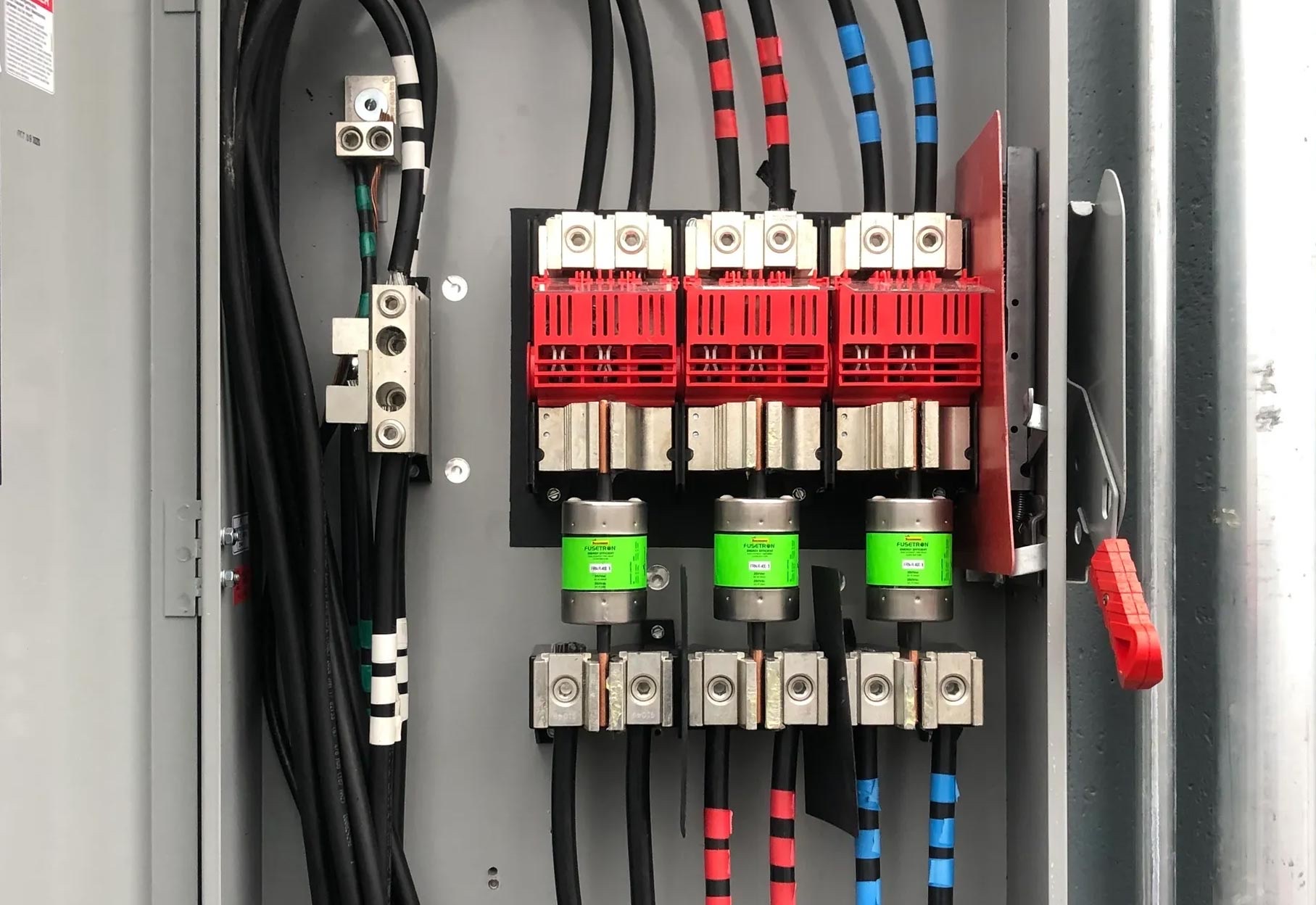
Behind that sits machine and motor connections, three-phase distribution and switchgear, and the conduit and branch circuits that get power to the floor. Rotation is checked on every three-phase motor, because a pump or compressor running backward can be damaged immediately.
The recurring exposure in a working plant is unplanned downtime, which is what scheduled maintenance with thermal imaging is for. A loose or corroded connection runs hot under load for months before it fails, and that is the failure mode behind most unplanned outages.
Underneath the building types, commercial buyers are asking the same three questions, and none of them is what the work costs.
The first is who carries the license. Austin Provencher holds New Hampshire master electrician license 14569M and is separately licensed in Massachusetts. A master license is the tier the state holds responsible for a job: it is what a permit is pulled under, what an inspection signs off against, and what an insurance certificate references. An electrical license does not cross a state line, so a contractor holding only one cannot pull a permit in the other state, which matters constantly for businesses near the border.
The second is what the work interrupts. Cutovers, service work and anything inside the gear need the power off, and the useful question is when rather than whether. Most other work can be done area by area with only the circuit being worked on isolated. Our guide to keeping a business open during electrical work covers how those windows are found.
The third is whether the same people come back. Recurring work is work we want rather than tolerate, and for most commercial buildings a planned arrangement costs less than the emergency call-outs it replaces. What preventive maintenance actually prevents sets out what a survey typically turns up.
Commercial reach is deliberately wider than residential, because a job of real size justifies a drive that a service call does not.
In practice that means the commercial and industrial corridors of the region: the Manchester millyard and the Route 293 belt, downtown Nashua and the Everett Turnpike through Merrimack, Concord and the Loudon Road commercial district, Bedford and Hooksett, the I-93 towns of Salem, Derry and Londonderry, Pease International Tradeport and the Newington industrial area, Portsmouth, Dover, Rochester and Somersworth on the Seacoast, and Keene to the west.
Over the state line the work runs through the Merrimack Valley: Lowell, Lawrence, Haverhill, Methuen, Andover, Tewksbury and Dracut, which is where the mill stock and the industrial base sit on the Massachusetts side.
The service area page sets out the whole geography market by market, and the commercial services page covers the twelve areas of work behind all of this.
Yes, and it is the building type we have the most work behind us in, including a brewery and a restaurant in the Manchester area. Kitchen equipment loads, three-phase, hood interlocks and the fire suppression shunt trip are all part of it. The equipment schedule is the thing we need first.
Because we have not put a named job behind them yet. An industry with real work behind it is written as work we do; one without is described as what that building type needs, with a plain statement that we take it on. Claiming to specialize in a building type we have never worked in is worth nothing to the person reading it.
Yes. A. Pro Electric is already affiliated with several large property management firms. That work covers reactive tenant calls, planned common area and infrastructure work, and turnovers between tenancies, usually across several buildings under one arrangement.
Usually, and it is worth establishing up front which parts genuinely need the power off. Cutovers, service work and anything inside the gear do; most circuit and lighting work does not. Retail and food service work generally goes overnight or into a closed day, and industrial work fits between shifts.
Yes, under a separate Massachusetts license held alongside the New Hampshire master license. Electrical licenses do not cross state lines, so a contractor holding only one cannot legally pull a permit in the other state. For a business with sites either side of the border that means one contractor rather than two.
No. The work is the same work, and the building types on this page are about where we have proof rather than where we are able. Call and ask what we have done that is closest to your building, and we will tell you plainly.
Yes, and it is usually easier for everyone than treating each site as a separate job. It is the normal shape of the property management and maintenance work, and with licenses in both states a portfolio that straddles the border runs as one arrangement.
We do, under the master electrician license, in whichever state the building sits in. On a fit-up that also means lining the inspection sequence up with the other trades, and on anything involving the utility the disconnect and reconnect are scheduled with them rather than assumed.
The services behind the industry we know best, in roughly the order a job runs.
Restaurants, retail, offices and warehouses, rough-in to trim.
Kitchen equipment, motors, rooftop units and process circuits.
LED retrofits, parking lot and site lighting, controls, high-bay.
Downtime response, storm and outage work, temporary power.
Scheduled maintenance, thermal scanning, planned replacement.
Three-phase service, panelboards, transformers and feeders.