

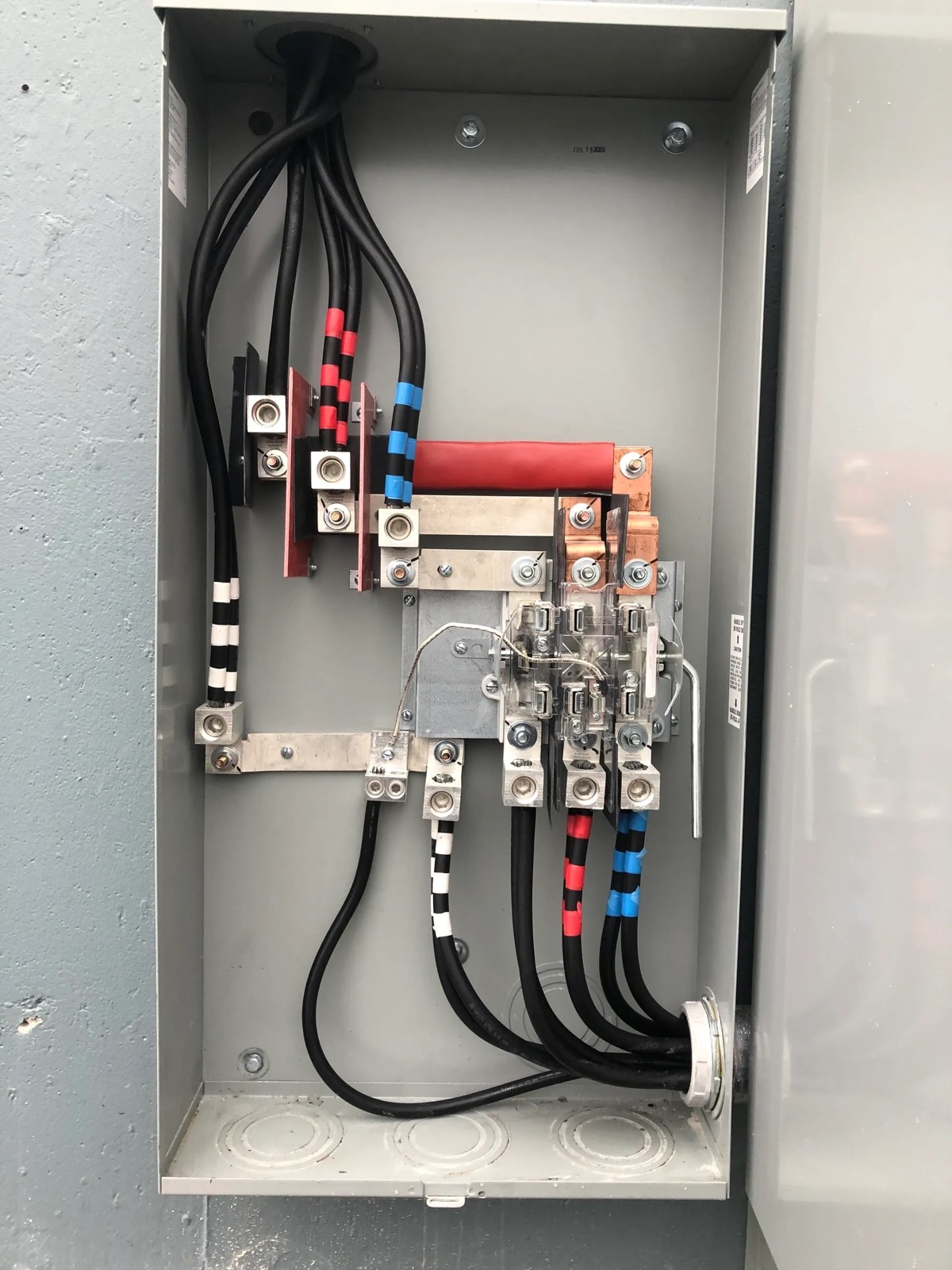
Preventive Maintenance: What It Actually Prevents
What thermal imaging finds before it fails, what belongs in a maintenance scope, and what deferring it actually costs a business.
Published
What Commercial Electrical Maintenance Actually Prevents
What Does Electrical Preventive Maintenance Actually Prevent?
Electrical preventive maintenance prevents the failures that give warning, which is most of them. Electrical equipment very rarely fails without notice; it fails slowly, warms up, and then fails suddenly. The whole discipline is about finding the slow part.
The single most common cause of commercial electrical failure is a connection that has loosened. Terminations work loose through thermal cycling, through vibration, and sometimes because they were never torqued correctly. A loose connection has resistance, resistance under load makes heat, heat accelerates the loosening, and the cycle runs away. The end of it is a burnt termination, a failed breaker, a damaged busbar or a fire.
The beginning of it is a joint running a few degrees warmer than its neighbors, which is invisible to anyone looking at the panel and obvious to a thermal camera.
That is the trade. Finding the warm joint during a scheduled visit costs an hour. Finding it when it fails costs a shutdown, an emergency callout, damaged equipment and whatever the business loses while it is down.
We run scheduled maintenance for businesses and managing agents across New Hampshire and northern Massachusetts, in Manchester, Nashua, Concord, Portsmouth and Pease, and over the border in Lowell, Lawrence, Haverhill and Methuen.
What Is Thermal Imaging and Why Does It Matter?
Thermal imaging surveys energised equipment with an infrared camera and shows the temperature of every connection, so a joint running hotter than it should stands out plainly against the ones around it.
It matters because it is the only practical way to find a developing fault without taking the building apart. The equipment stays energised and under normal load, which is exactly the condition that reveals the problem, and nothing has to be shut down to do the survey.
What it finds is consistent. Loose or corroded terminations, unbalanced phases, overloaded circuits, failing breakers, and connections that were never correctly torqued. On a switchboard or a panelboard those are the failures that cause unplanned outages, and they are all visible as heat long before they are visible any other way.
On a building with real distribution, a thermal survey is the highest-value hour in the maintenance program, and on a switchboard it is what stands between a scheduled repair and an unplanned shutdown. Infrared and thermal scanning is normally scheduled annually, and more often on equipment that is heavily loaded or in a harsh environment.
What Should a Commercial Electrical Maintenance Visit Cover?
A defined scope rather than a look around, and the scope should be written down so both sides know what was and was not done.
The core of it is the distribution. Thermal survey of panels, switchboards and disconnects under load. Physical inspection of enclosures for corrosion, water ingress, rodent damage and heat marking. Checking and correcting terminations where the equipment can be safely isolated. Verifying labelling still matches reality, which in a building that has had tenants come and go it usually does not.
Then the systems with their own requirements. Emergency and exit lighting tested and recorded. Generator and transfer switch exercised, and load tested where the installation warrants it. GFCI and RCD-type devices tested rather than assumed.
Then the things specific to the building: rooftop equipment connections in a coastal location, motor circuits in an industrial unit, and kitchen equipment connections in hospitality. The last part of any visit should be a written record of what was found and what needs attention, because a maintenance program with no paper trail is a series of visits rather than a program.
How Often Does Commercial Electrical Equipment Need Inspecting?
It depends on the environment and the load far more than on the calendar, and a sensible program reflects that rather than treating every panel the same.
Annually is a reasonable baseline for general commercial distribution in a clean, dry, moderately loaded building. An office, a retail unit or a professional practice usually sits here.
More often makes sense where the environment is working against the equipment. A commercial kitchen, with grease, heat and constant cleaning. A coastal site, where salt air reaches outdoor equipment, which around Portsmouth, Newington, Hampton and Rye is a genuine factor rather than a theoretical one. An industrial unit with vibration and dust. Anything heavily loaded for long periods, which includes most warehouse and process equipment.
Life safety systems have their own testing frequencies and those are not discretionary. Emergency lighting and fire alarm testing intervals are set by code and by the authority having jurisdiction, and the records matter as much as the tests.
Is a Maintenance Contract Worth It for a Small Business?
It depends on what an unplanned outage costs, and for a lot of small businesses the honest answer is that a scheduled annual visit is enough and a full contract is not.
Where a contract earns its place is where downtime is expensive or where the equipment is working hard. A restaurant with refrigeration and a kitchen full of connections. A food retailer. A building with a generator and life safety systems that have to be tested and recorded anyway. A managed portfolio where somebody has to be responsible for the records.
Where it is harder to justify is a small office or a light retail unit with a modest panel and no equipment. An inspection every year or two, and a number to call when something happens, covers the risk proportionately.
What a contract genuinely adds beyond the visits is response. A contracted customer is a known building with known equipment, and that shortens a callout considerably. Turning up to a building already documented is a different job from turning up to one where nothing is labeled.
What Does Deferred Electrical Maintenance Cost a Business?
More than the maintenance, and it is worth being concrete about how rather than simply asserting it.
The direct cost is the failure itself: emergency callout rates, replacement equipment at whatever it costs today rather than what it could have been ordered for, and the damage a failure causes to what is connected to it. A failed breaker is cheap; a burnt busbar in a panelboard is not, and the latter is usually the former left alone. Replacing distribution gear as planned work costs a fraction of replacing it at two in the morning.
The indirect cost is the outage, and for most businesses it dwarfs the repair. A restaurant losing a Friday evening. A warehouse unable to ship. A manufacturer with a process stopped part way. Stock lost to a refrigeration failure. Those are the numbers that make the arithmetic obvious, and they are the numbers nobody adds up until it happens.
Then the compounding cost, which is that neglected distribution gets progressively harder to work on. Labelling that stopped being accurate, circuits added without record, and panels nobody has opened in years all mean every future job starts with an investigation. That is billable time spent finding out what should already be known.
What Should Be in a Commercial Maintenance Agreement?
A defined scope, a schedule, a written record, and a response arrangement. Anything vaguer than that is a retainer rather than a maintenance program.
The scope should say which equipment is covered and what is done to it, including whether thermal imaging is included and at what frequency. The schedule should say how often and roughly when, so visits can be planned around trading rather than negotiated each time.
The record is the part most often missing and the part that matters most. Every visit should produce a written report of what was inspected, what was found, what was corrected and what needs attention, with the last of those prioritised. Over a few years that becomes the history of the building, which is worth something in itself when equipment is being replaced or the building is sold. For a managing agent it is also what turns a portfolio into something that can be budgeted rather than reacted to.
Preventive maintenance is the least dramatic work in this trade and the only kind that is cheaper than the alternative. We run scheduled maintenance, thermal surveys and testing for businesses and managing agents across Manchester, Nashua, Concord, Portsmouth, Pease and Keene, and in the Merrimack Valley on the Massachusetts license.
Last updated
Electrical Maintenance Questions
Does Thermal Imaging Need the Power On?
Yes, and under normal load, because heat is what reveals the fault. A panel surveyed with equipment switched off shows nothing useful. That is also why it is a safe survey from the building's point of view, since nothing is interrupted to do it.
How Long Does a Maintenance Visit Take?
It depends on how much distribution there is. A small commercial unit with one panel is a short visit. A building with a switchboard, several panels, a generator and life safety systems is most of a day, and the written record afterwards is part of the work rather than an extra.
Can Maintenance Be Done During Business Hours?
Most of it, yes. Thermal imaging and inspection happen with everything energised and running, which is exactly the condition needed. Only the parts requiring isolation, such as correcting a termination, need a circuit dead, and those are short and schedulable.
What Records Should We Keep of Electrical Maintenance?
What was inspected, what was found, what was corrected and what needs attention, dated, for every visit. Over a few years that becomes the history of the building, which matters when equipment is replaced, when a building is sold and when an insurer asks.
Will Maintenance Find Everything Before It Fails?
Not everything, but most of it, because the common failures give warning. Loose terminations, overloaded circuits and failing breakers all announce themselves as heat long before they fail. Sudden failures with no prior signature do happen and they are the minority.
Do We Need Maintenance If the Building Is New?
Less of it, and not none. New installations settle, and terminations that were correct on commissioning can loosen through the first year of thermal cycling. A survey after the first year of operation catches that, after which a normal interval applies.
The Work Behind This Guide
More Guides for Businesses
Planning the Electrical for a Restaurant Fit-Up
Kitchen equipment loads, the inspection sequence, and the decisions that are expensive to change late.
Three-Phase Power: What It Is and When a Business Needs It
Why some equipment will not run on single phase, and what bringing three phase into a building involves.
LED Retrofit: Working Out the Payback
Fixture count, running hours and rate, and how to tell a real payback figure from a sales one.