

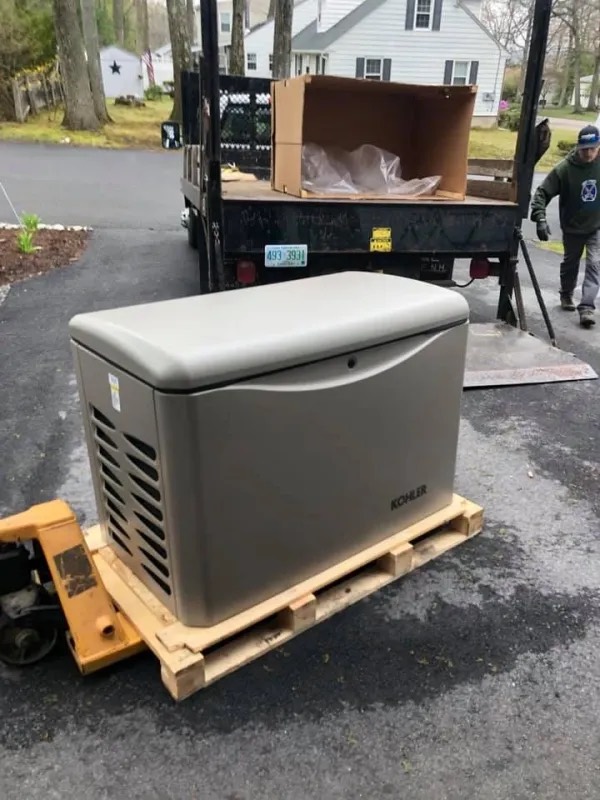
What a Standby Generator Protects in a Business
Sizing from connected load rather than floor area, why the transfer switch is the installation, and what an outage actually costs a business.
Published
What a Standby Generator Protects in a Commercial Building
What Does a Commercial Standby Generator Protect?
A commercial standby generator protects whatever it has been sized and connected to protect, and for a business the useful way to think about it is not "the building" but "the things that cost money when they stop".
Those divide into three groups and they are worth separating before anybody sizes anything. Life safety comes first and is not optional, covering emergency lighting, exit signage, fire alarm and, in some buildings, elevators and smoke control. Code decides that group rather than the business, and life safety and emergency power is inspected on its own terms.
Second is anything where an outage destroys value rather than pausing it. Refrigeration and freezers in a restaurant, a food retailer or a laboratory. Process equipment part way through a cycle. Servers and network. Anything with stock or data that does not survive the interruption.
Third is trading capability, which is what turns an outage from an inconvenience into lost revenue. Point of sale, card processing, lighting and heating in a customer area, and the equipment the business actually sells with. Losing those is what turns a storm into an after-hours callout.
Where the building is changes the arithmetic. A commercial street in Manchester, Nashua or Portsmouth is usually restored quickly, while a site out towards Keene, or a Massachusetts industrial park in Methuen or Dracut at the end of a line, may not be.
How Is a Commercial Generator Sized?
From the running load of the circuits it will carry, plus the largest single starting surge, and the second half is where most oversizing happens.
Motors draw far more starting than running. A compressor, a walk-in condensing unit, a rooftop HVAC unit or an elevator can pull several times its running figure for the first second. The generator has to survive the worst instant, which is the largest of those starting while everything else is already running.
What it does not have to survive is every motor starting simultaneously, because they do not. Sizing as though they might is the most common reason a quoted unit is considerably larger and more expensive than the building needs. On a commercial building with several large motors the difference between those two methods is substantial.
The other lever is load management and staged starting, which brings equipment up in sequence rather than together and frequently allows a smaller unit to carry the same building. On a larger installation that is worth pricing against the cost of the extra capacity. Commercial generator systems and transfer switches are sized on the actual connected load rather than on floor area.
What Is an Automatic Transfer Switch and Why Does It Matter?
An automatic transfer switch senses the loss of the utility supply, starts the generator, waits for it to stabilise and moves the load across, then reverses the process when the utility returns. On a commercial installation it is not an upgrade, it is the installation.
The safety function is absolute and it is why no legitimate installation omits it. A generator connected without a transfer switch can push power back onto the utility network, where crews are working on conductors they have isolated and expect to be dead. The switch physically prevents the two sources from ever being connected at once.
The operational function is why businesses want the automatic version rather than a manual one. Typical changeover is within about half a minute, unattended, at three in the morning, whether or not anyone is in the building. For a business with refrigeration or a process running overnight, that is the whole point.
Life safety loads have their own requirements about how quickly they must be restored and how they are separated from everything else, which is why an emergency system is often a distinct arrangement rather than simply more circuits on the same switch.
Does a Business Need a Generator or a UPS?
They solve different problems and a lot of buildings need both, which is worth understanding before buying either.
A UPS covers the gap. It carries the load instantly, with no break at all, for a period measured in minutes. That is what protects servers, tills, controls and anything that cannot tolerate even a momentary interruption, including the moment while a generator is starting.
A generator covers duration. It takes tens of seconds to come on load and then runs for as long as there is fuel. That is what protects refrigeration, heating, lighting and the ability to keep trading through a multi-day outage.
The common arrangement on a commercial site is a UPS on the sensitive loads and a generator behind it, so the UPS rides through the changeover and the generator carries the day. A business with only a UPS is protected for minutes. A business with only a generator has a gap at the start of every outage, which for IT equipment is the part that does the damage.
Is a Standby Generator Worth It for a New Hampshire Business?
It depends on what an outage actually costs the business per hour, and that figure varies enormously between buildings a mile apart.
The regional case is real. Ice storms take conductors and limbs down across the wooded parts of the state every winter, and restoration is prioritised by the number of customers on a line. A business on a dense commercial street in Manchester, Nashua or Portsmouth is usually back quickly. One on a rural commercial property, an industrial site at the end of a line, or anywhere out towards Keene or the Monadnock towns can be considerably longer.
On the Seacoast the profile is different rather than milder. Coastal storms bring wind and salt, and Portsmouth, Newington, Hampton and the Pease tenants see outages driven by weather that inland sites do not, along with salt reaching outdoor equipment that then needs checking more often than an inland site would.
The businesses where the arithmetic is easiest are the ones holding perishable stock, running a process that cannot be interrupted, or trading in a way that simply stops without power. For an office that can send people home for a day, it is a genuinely different calculation and frequently the answer is no.
What Maintenance Does a Commercial Generator Need?
More than most owners expect, and the maintenance is the difference between an asset and an expensive object that fails when it is finally needed.
Standby sets self-exercise, typically running briefly each week or month to circulate oil and keep everything free. That is automatic and it is the minimum rather than the whole program. Oil and filters need changing on schedule. The battery needs replacing every few years and is the single most common reason a generator fails to start. Coolant, air filters, belts and the fuel system all need attention, and diesel in particular degrades in storage and needs managing.
The transfer switch needs testing too, and it is routinely forgotten. An automatic transfer switch that has never been exercised under load is an untested assumption. A generator that starts perfectly into a switch that does not transfer is a generator that did nothing.
Load bank testing is the one that matters on larger sets, and on a site with standby generator systems it is what proves the set will actually carry the building. A generator that only ever self-exercises unloaded can develop problems that never show up until it is asked to carry the building. Scheduled testing under load is how those are found in advance, and it is a normal part of a preventive maintenance contract rather than an extra.
Does a Commercial Generator Installation Need a Permit?
Yes, and usually more than one approval. The electrical work is permitted and inspected, and the transfer switch is the first thing an inspector looks at.
Beyond the electrical permit there are commonly siting requirements from the town covering distance from the building and the property line, noise, and screening. Fuel brings its own: a propane or diesel tank has storage requirements and in many cases fire department involvement. On a commercial building the fire marshal may have a view on emergency and life safety systems specifically.
For life safety loads there are additional requirements about how quickly power must be restored, how those circuits are separated from general standby loads, and how the system is tested and recorded. Those are not optional and they are inspected.
The practical implication is lead time. The equipment order, the utility if the service is affected, the permits and the siting approvals all run in parallel and the longest of them sets the date. Starting that conversation early costs nothing and starting it late costs a season.
What Should a Business Decide About Backup Power?
What the outage actually costs, which loads genuinely cannot stop, and whether anyone is on site to act. Those three answers size the system and decide whether it is automatic.
The sequence that works is to list the loads that must run, separate the life safety ones that code requires from the commercial ones the business chooses, size from the connected load rather than the floor area, and then decide on fuel and siting, both of which constrain where the unit can go and how long it runs.
The transfer switch is not part of the decision, because there is no compliant installation without one.
A commercial standby generator earns its cost in proportion to how long the power stays off and how much the business depends on it, which is why a food business, a laboratory or a process operation reaches a decision quickly and an office often does not. We size, install and maintain commercial standby systems across Portsmouth and Pease, Manchester, Nashua, Concord, Keene and Lebanon, and across the border in Lowell, Lawrence, Haverhill and Methuen.
Last updated
Commercial Generator Questions
How Quickly Does a Standby Generator Take Over?
Typically within about half a minute with an automatic transfer switch, which covers the load but is not instant. Anything that cannot tolerate that gap, such as servers, tills and controls, needs a UPS in front of it to ride through the changeover.
Can a Generator Run a Whole Commercial Building?
It can, and it is usually not the best value. Carrying everything needs a considerably larger unit and normally load management as well. Most businesses get more for their money from a properly sized system covering the loads that actually cost money when they stop.
What Fuel Should a Commercial Generator Use?
Natural gas where it is available, since there is no tank and no refuelling during an extended outage. Propane suits sites without gas, with tank size deciding run time. Diesel is common on larger installations and needs fuel management, because stored diesel degrades.
How Often Should a Generator Be Tested Under Load?
Regular self-exercise is automatic but it runs unloaded or lightly loaded, which hides problems that only appear under real demand. Scheduled load bank testing is how those are found in advance, and on a larger set it is part of a maintenance program rather than an extra.
Does a Generator Need to Be Enclosed or Screened?
It arrives in a weather enclosure. What varies is what the town requires on top of that for noise, distance from the property line and appearance, and on a commercial site the fire department may also have a view on fuel storage. Those are established before the pad goes in.
Is a Generator Required by Code for Our Building?
For most commercial buildings no, but emergency and life safety systems have their own requirements, and in some occupancies a standby supply for those is mandatory. That is decided by occupancy type and by the authority having jurisdiction rather than by preference.
The Work Behind This Guide
More Guides for Businesses
Planning the Electrical for a Restaurant Fit-Up
Kitchen equipment loads, the inspection sequence, and the decisions that are expensive to change late.
Three-Phase Power: What It Is and When a Business Needs It
Why some equipment will not run on single phase, and what bringing three phase into a building involves.
LED Retrofit: Working Out the Payback
Fixture count, running hours and rate, and how to tell a real payback figure from a sales one.